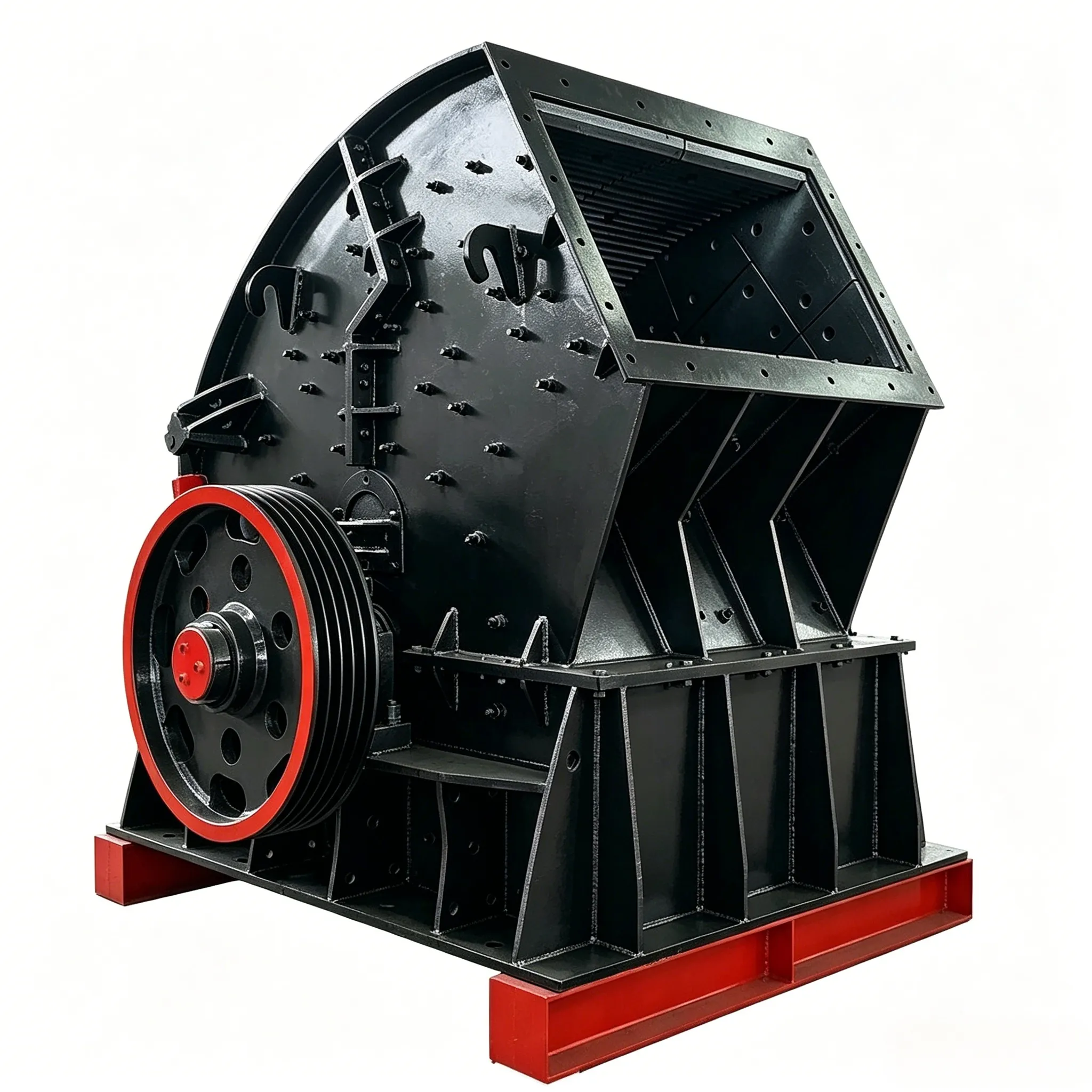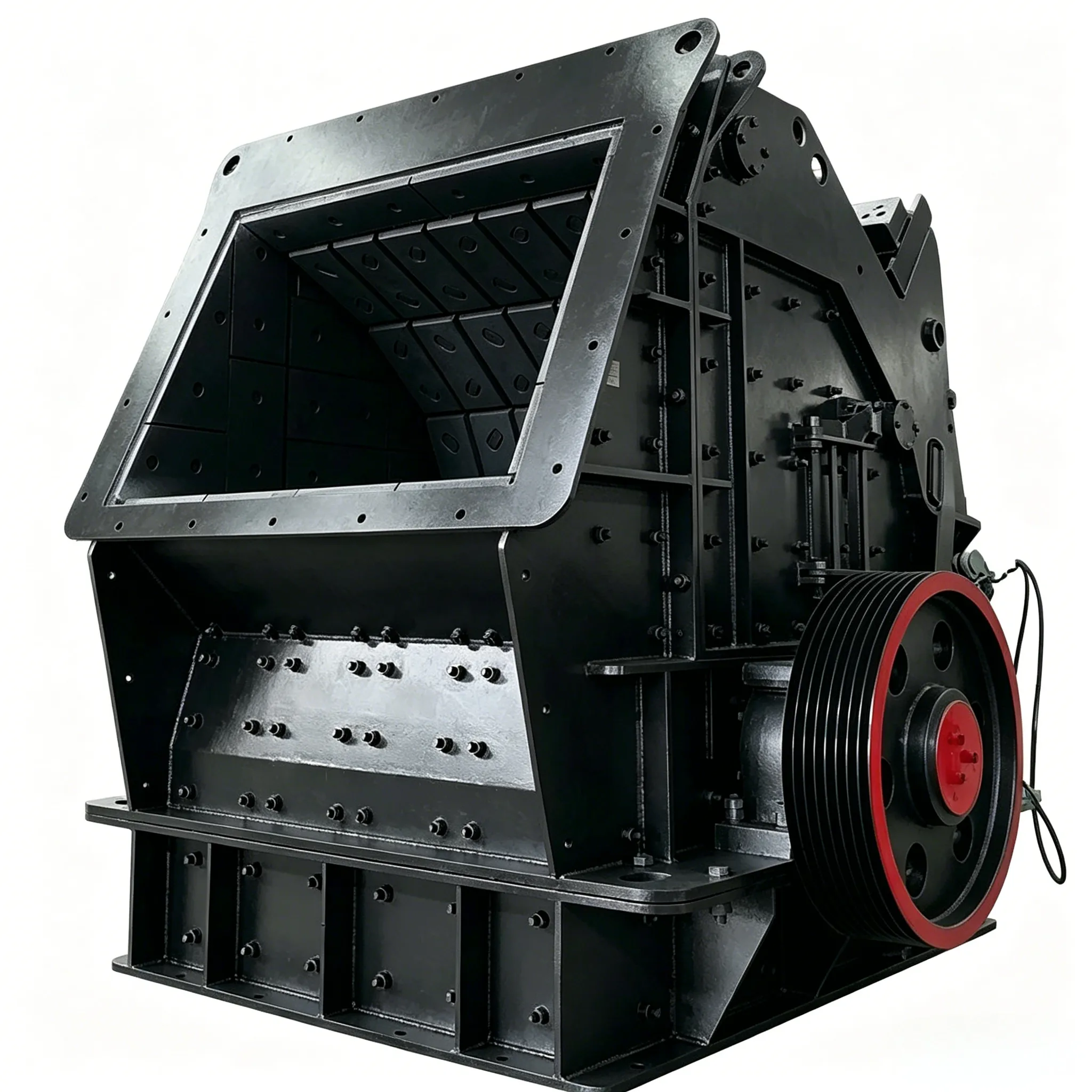

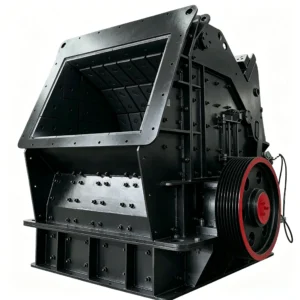
Impact crusher is a device that uses impact energy to crush brittle materials of medium hardness. Since its introduction in Germany in 1942, it has developed rapidly over just over 60 years. Currently, it is widely used in industries such as cement
Impact crusher is a device that uses impact energy to crush brittle materials of medium hardness. Since its introduction in Germany in 1942, it has developed rapidly over just over 60 years. Currently, it is widely used in industries such as cement, electric power, building materials, chemicals, coal, and metallurgy in China. In addition to the advantages shared with hammer crushers—such as a high crushing ratio, uniform product size with minimal over-crushing, low energy consumption, easy manufacturing, and convenient maintenance—the impact crusher also offers benefits like a wide adjustment range for product size and the ability to perform selective crushing. Therefore, there was once an attempt in China to replace hammer crushers with impact crushers. Since China began producing impact crushers in 1958, after more than 50 years of development, their technical performance has now approached advanced international levels. They not only meet the needs of national economic construction but are also exported abroad.
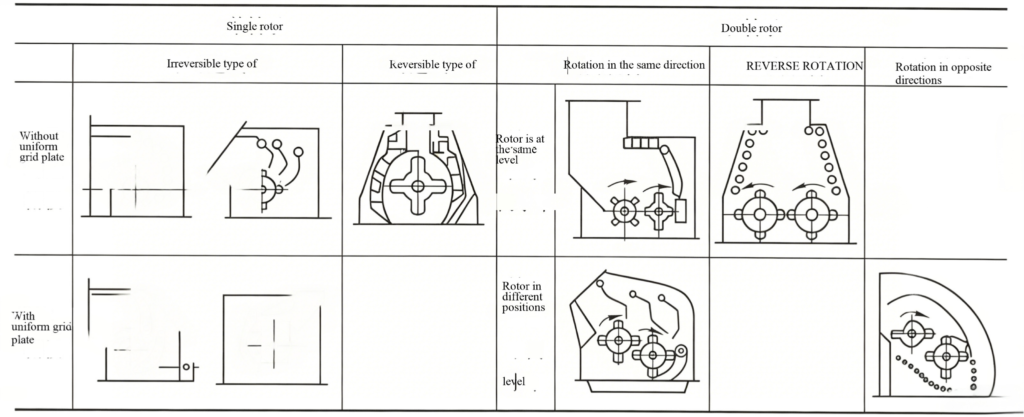
There are many types of impact crushers, mainly divided into two major categories: single-rotor and double-rotor. The classification is detailed in Table 6-1.
Table 6-1 Classification table of impact crushers
The working principle of an impact crusher is similar to that of a hammer crusher: both use high-speed rotating hammers to impact and break the ore. However, the crushing processes of the two are not exactly the same. Figure 6-1 shows a schematic diagram of the working principle of an impact crusher.
When the ore enters the crushing chamber, it is immediately impacted by the high-speed rotating plate hammers, resulting in selective crushing. The ore gains huge kinetic energy from the impact and is thrown at high speed toward the first-stage impact plate. Due to the rebounding action of the impact plate, the ore is crushed again. The ore bounced back from the impact plate is once again struck by the plate hammers, and the above crushing process is repeated. After that, the crushed ore is again thrown at high speed toward the second-stage impact plate for further crushing.
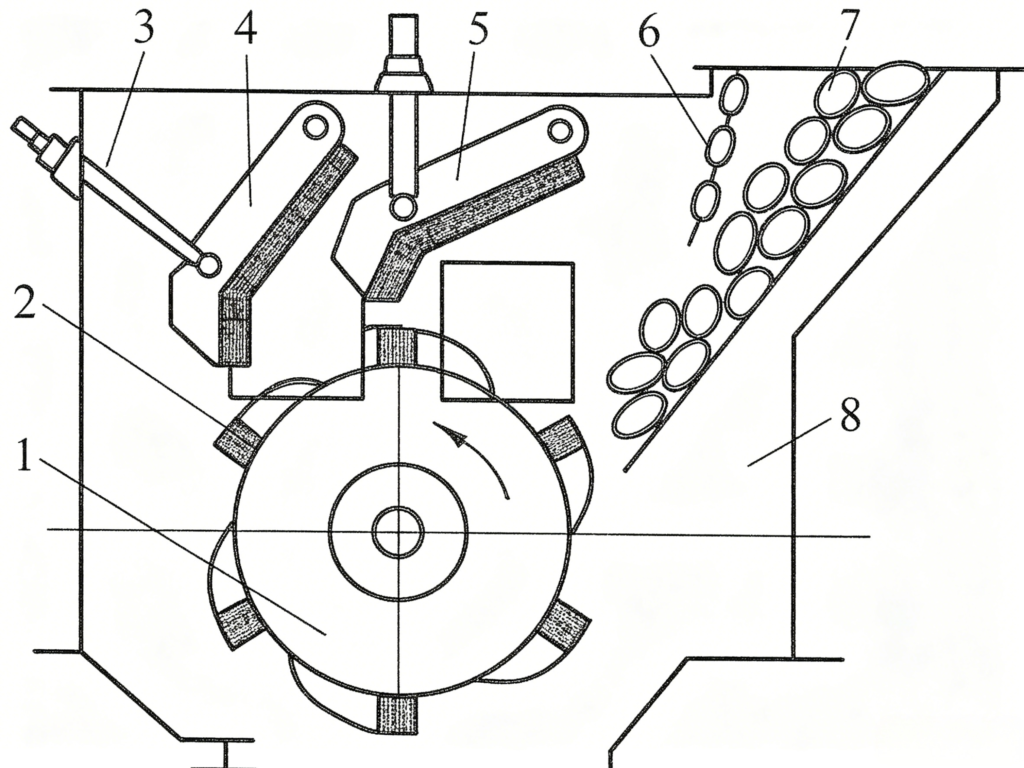
Fig. 6-1 Working principle schematic of impact crusher
1 Rotor; 2 Plate hammer; 3 Tie rod; 4 Second-stage impact plate; 5 First-stage impact plate; 6 Chain; 7 Feed opening; 8 Main frame
In this way, under the continuous multiple impacts of the plate hammers and impact plates, as well as the collision between the ore particles themselves, the ore continuously cracks along its natural cleavage planes, loosens, and is crushed. When the particle size becomes smaller than the gap between the plate hammers and the impact plates, the material is discharged from the lower part of the machine as qualified product.
An example illustrating the meaning of the model and specification of an impact crusher is as follows:
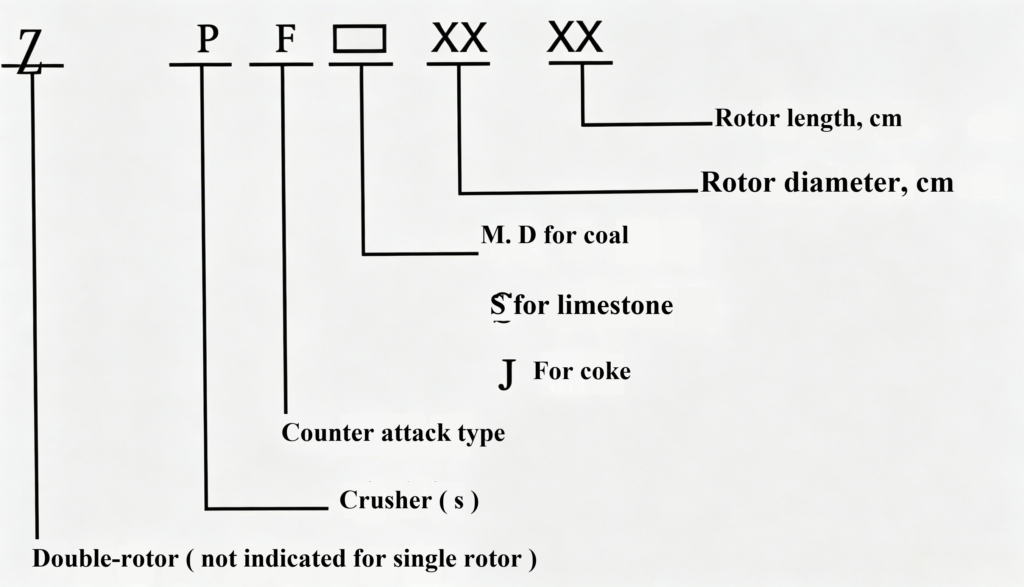
The impact crushers produced in China can be generally divided into two types according to their application: the ordinary type (PF series) and the coal-use type (PFD or PFM series), with about 14 main specifications for each. The ordinary impact crusher can be used in industries such as mineral processing, chemical engineering, cement, construction, refractories, ceramics, and glass, for crushing medium-hardness ores, rocks, slag, etc. Among them, the single-rotor type is generally used for medium and fine crushing, while the double-rotor type is used for coarse crushing and single-stage crushing. Their technical parameters are listed in Table 6-2.
Table 6-2 Technical parameters of various types of impact crushers
| Type | model | feed size/mm | output size/mm | capacity/t ·h-¹ | power/kW | weigh/t |
| Single-rotor impact crusher | PF0504 | 100 | 20~0 | 4.~10 | 7.5 | 1.35 |
| PF0706 | 180 | <30 | 8-12 | 22~30 | 10.4 | |
| PF1007 | 250 | <25 | 15-35 | 37 | 6.32 | |
| PF1210 | 250 | <50 | 40~80 | 95 | 15.25 | |
| PF¹310 | 400 | <50 | 80~120 | 90~110 | 12.00 | |
| PF1315 | 500 | <50 | 160-250 | 180~260 | 19.00 | |
| PF1320 | 500 | <50 | 300~350 | 300-375 | 24.00 | |
| PF1416 | 155 | 35.47 | ||||
| PF1614 | 155 | 36.63 | ||||
| Double-rotor impact crusher | 2PFA0808 | 350 | <20 | 18~30 | 37+55 | 19.1 |
| 2PFA1010 | 450 | <20 | 30~50 | 55+75 | 28.63 | |
| 2PFA1212 | 850 | <20 | 50~90 | 132+160 | 64.00 | |
| 2PF1416 | 2×155 | 54.10 | ||||
| 2PF1820 | 2×280 | 83.00 |
Structure of a Single-Rotor Impact Crusher
Impact crushers are classified into single-rotor and double-rotor types according to the number of rotors. Figure 6-2 shows a φ1250mm×1000mm single-rotor impact crusher produced in China. The structure of this crusher is relatively simple, mainly consisting of a frame, a transmission mechanism, a rotor, plate hammers, and impact plates.
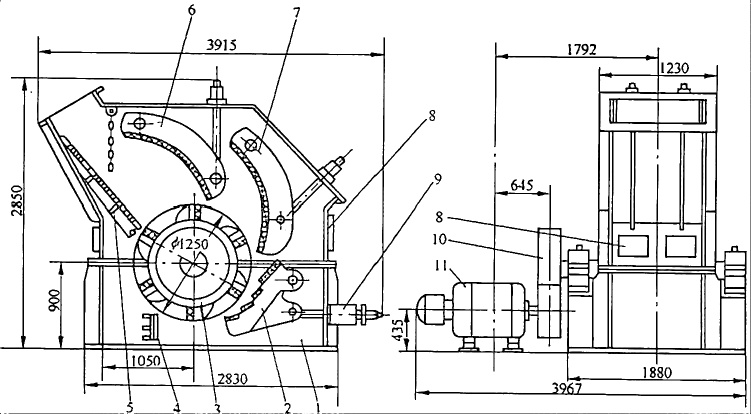
Figure 6-2 φ1250mm×1000mm single-rotor impact crusher
1—frame (body); 2—homogenizing plate (apron plate); 3—rotor; 4—plate hammer (striking plate);
5—screen plate (grate plate); 6—first impact plate; 7—second impact plate; 8—door;
9—spring adjustment unit (spring adjusting part); 10—pulley (belt pulley); 11—electric motor
Structure of the Impact Crusher
The frame of the impact crusher consists of an upper frame and a lower frame, which are connected to each other by bolts. The part above the rotor axis is the upper frame, which is equipped with side doors and a rear door for maintenance and installation. The part below the rotor axis is the lower frame, which is fixed to the foundation by bolts and mainly bears the weight of the entire machine. All parts inside the frame that come into contact with the ore are lined with replaceable wear-resistant liners. A chain curtain is installed at the feed opening of the crusher to prevent ore from flying out of the machine during crushing and causing accidents.
The transmission mechanism of the impact crusher is very simple: the motor directly drives the main shaft and rotor to rotate at high speed through a belt pulley. The main shaft is supported by rolling bearings in bearing housings on both sides of the frame. The bearings are generally lubricated periodically with grease.
In terms of working principle, the biggest difference between an impact crusher and a hammer crusher is that the hammer crusher relies on hinged suspended hammers, whereas the plate hammers of the impact crusher are rigidly connected to the rotor, using the rotational inertia of the entire rotor to impact and break the ore. Therefore, the rotor must have sufficient mass to meet the requirements of ore crushing. If the rotor mass is too light, the crushing efficiency will decrease. Of course, it cannot be too heavy either, otherwise the crusher will be difficult to start.
The rotor of an impact crusher generally adopts a one-piece cast steel structure. This type of structure has a large mass and can easily meet the mass energy required by the crusher; at the same time, it is sturdy and durable, facilitating the installation of plate hammers. Some impact crushers use a rotor assembled from several cast steel or structural steel discs stacked together. This assembled rotor is easy to manufacture and balance. Some small impact crushers use a hollow rotor welded from steel plates. Although its structure is simple and easy to manufacture, its strength and durability are poor.
The impact plate is made of high manganese steel or other wear-resistant materials and is freely suspended inside the machine. One end of the impact plate is hinged to both ends of the frame via a suspension shaft; the other end is supported on the conical washer of the upper frame by a tie rod bolt using a spherical washer. This impact plate also serves as a safety device for the crusher. When an uncrushable object enters the machine, the impact force on the impact plate increases sharply, forcing the tie rod bolt to compress the spherical washer, causing the tie rod bolt to lift back and allow the uncrushable object to be discharged, thereby ensuring the safety of the entire machine. In addition, by adjusting the nut on the tie rod bolt, the gap between the plate hammer and the impact plate can be changed, thereby controlling the particle size range of the crushed product.
Since the impact plate directly participates in crushing, its shape and structure have a significant effect on crushing efficiency. To achieve the best crushing effect, theoretically the material should collide vertically with the surface of the impact plate. Currently, domestic impact crushers generally have impact plates made in a broken-line shape or an involute shape. The former has a simple structure and is easy to machine but cannot meet the requirements for optimal ore crushing; the latter allows the material to impact vertically at every point on the impact plate, thus achieving the best crushing effect. However, due to machining difficulties, an approximate involute shape composed of multiple arcs is generally adopted.
The number of impact plate stages in an impact crusher is generally two, and large crushers may have three stages.
The plate hammer, like the impact plate, is made of high manganese steel or other wear-resistant materials and is fixed on the rotor. There are generally three methods for fixing:
(1) Screw fixing method: The plate hammer is fixed with screws. This method is the simplest, but the screw heads are exposed on the striking surface and are easily damaged. Moreover, the screws are easily sheared off, causing the plate hammer to fly off the rotor and result in a serious accident.
(2) Clamp plate fixing method: The plate hammer is inserted laterally into the groove of the rotor, and clamp plates are used at both ends to prevent it from moving sideways. Because the plate hammer is made of wear-resistant material, machining is difficult, making it hard to ensure precise dimensions of the plate hammer, and it may become loose during operation due to insecure assembly.
(3) Wedge fixing method: The plate hammer is fixed on the rotor with wedges. During operation, due to centrifugal force, the plate hammer, wedge, and rotor become tighter as they rotate. This method is reliable and convenient for disassembly and assembly. Currently, this method is widely adopted for fixing plate hammers both domestically and internationally.
The number of plate hammers is related to the rotor diameter D. Generally, when D < 1 m, 3 plate hammers may be selected; when D = 1–1.5 m, 4–6 plate hammers may be selected; when D = 1.5–2 m, 6–10 plate hammers may be selected. In addition, when the ore is harder or the crushing ratio is larger, the number of plate hammers may be increased.
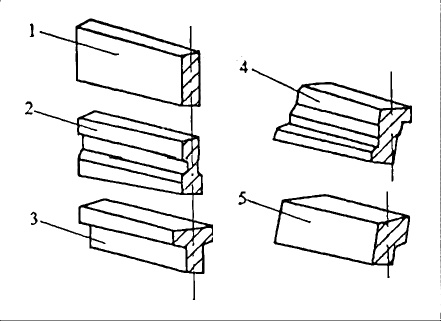
Figure 6-3 Shapes of plate hammers 1—Strip shape (rectangular); 2—I shape; 3—T shape; 4—S shape;
5—Axe shape
The plate hammer has many shapes; those commonly used in China are shown in Figure 6-3.
Structure of a Double-Rotor Impact Crusher
Double-rotor impact crushers can be further divided into three types according to the rotational direction and arrangement of the two rotors: (1) two rotors rotating in opposite directions, (2) two rotors rotating in the same direction, and (3) two rotors rotating in the same direction but with a certain height difference. Figure 6-4 shows a φ1250mm×1250mm double-rotor impact crusher produced in China.
In this crusher, the two rotors rotate in the same direction and are arranged in parallel with a certain height difference. This is equivalent to two single-rotor impact crushers used in series, with the first rotor acting as coarse crushing and the second rotor as fine crushing. However, the two rotors are equipped with different numbers of plate hammers, and the plate hammers differ in height and shape. In addition, the rotational speeds of the two rotors are also different. The first rotor has 8 plate hammers arranged in 4 rows, with a linear speed of 38 m/s; the second rotor has 12 plate hammers arranged in 6 rows, with a linear speed of approximately 50 m/s.
The two rotors of this crusher are driven separately by two motors via transmission devices consisting of elastic couplings, fluid couplings, and V-belts, rotating at high speed in the same direction. The first-stage rotor crushes ore of -850 mm to approximately -100 mm, which then enters the second-stage crushing chamber. The second-stage rotor further crushes the ore to -20 mm, after which it is discharged from the homogenizing screen plate of the machine body.
This crusher has a large crushing ratio, high output, and uniform product size, but its power consumption is also high.
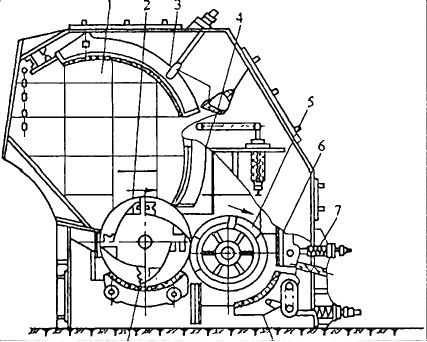
Figure 6-4 φ1250mm×1250mm double-rotor impact crusher
1—Frame (body); 2—First-stage rotor; 3—First impact plate;4—Chamber-dividing impact plate (partition impact plate);5—Second-stage rotor;6—Second impact plate;7—Adjusting spring;8—Second homogenizing screen plate (second-stage grate plate);9—First homogenizing screen plate (first-stage grate plate)