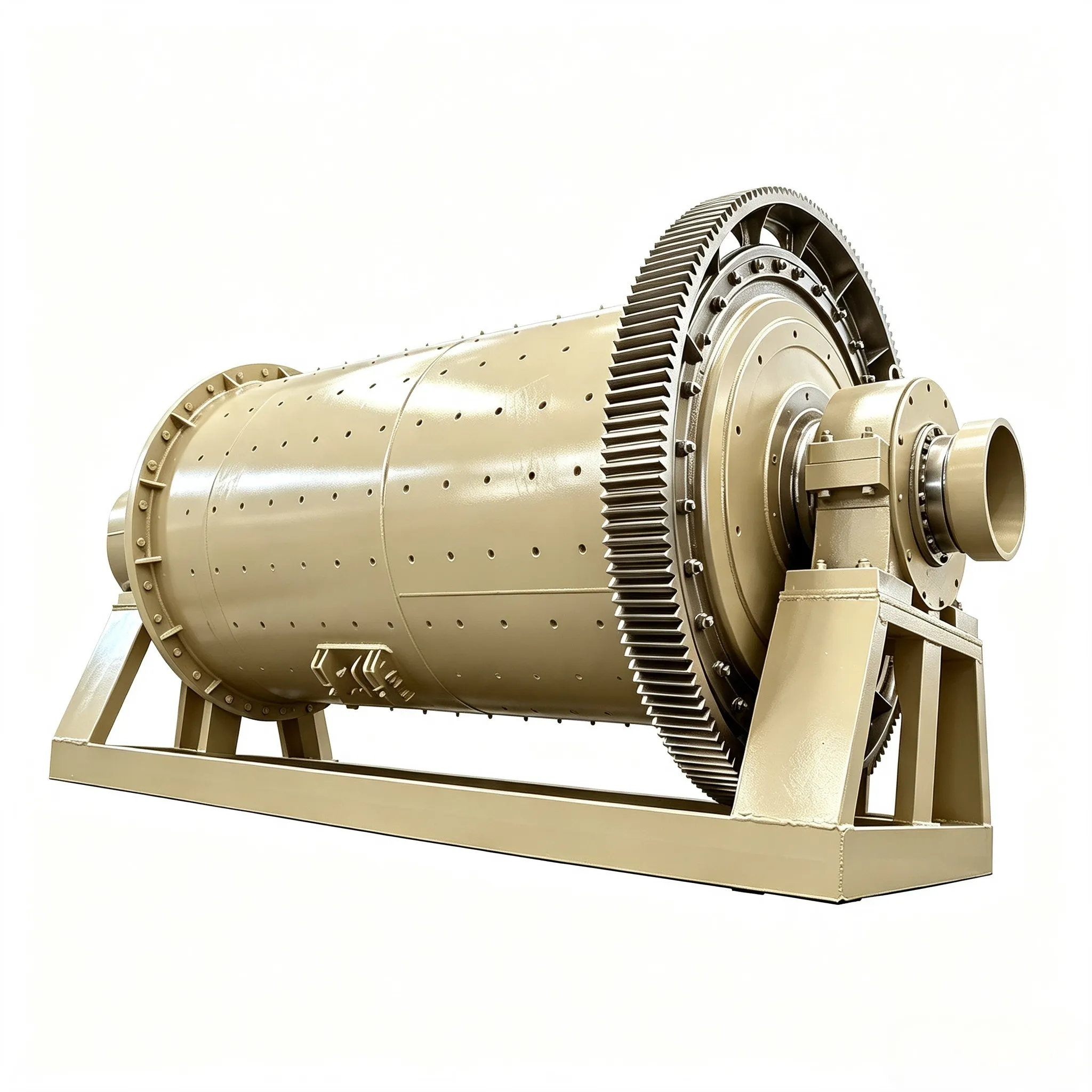
Pebble Mill
Construction of a Pebble Mill In some industrial sectors, such as chemical,…

Currently, the main process used in lean hematite beneficiation plants in Anshan is staged grinding, coarse and fine separation, gravity-magnetic separation-reverse flotation. The raw ore undergoes a first-stage grinding and classification process, followed by a first-stage overflow through a hydrocyclone for coarse and fine separation. Coarse particles are processed by gravity separation, while fine particles are separated by weak and strong magnetic separation, and the mixed magnetic concentrate is reverse-flotated. Both coarse and fine particles produce the final concentrate. The gravity concentrate and scavenged concentrate are then ground again by a secondary magnetic separator and returned to the hydrocyclone. The secondary magnetic tailings, strong magnetic tailings, and reverse flotation tailings are combined into a single tailings. The staged grinding, coarse and fine separation, gravity-magnetic-anion reverse flotation process at Anshan Iron and Steel Group’s Qidaishan and Dong’anshan sintering plants is shown in Figure 4-4. This process has the following characteristics.
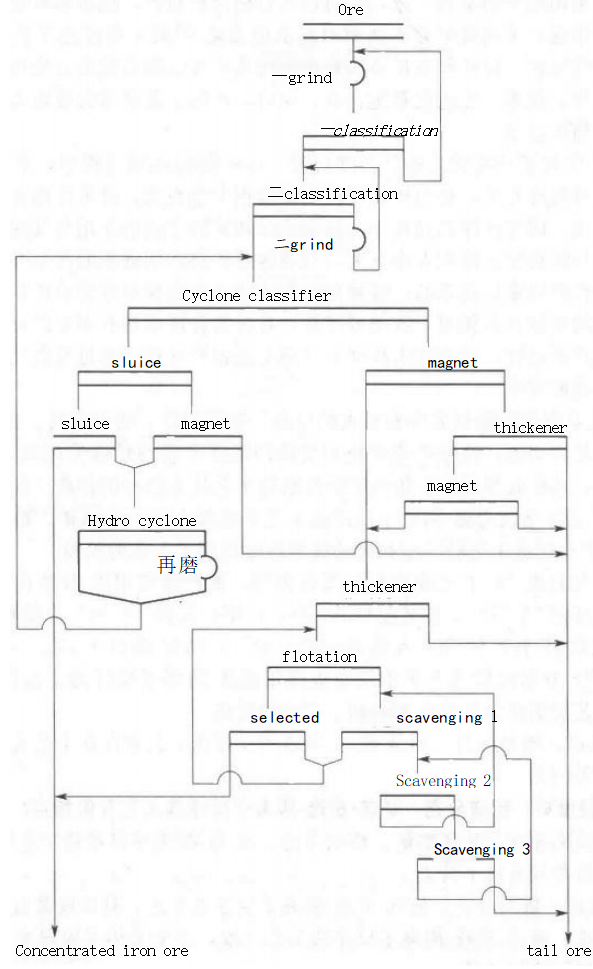
Figure 4-4 Process flow chart of staged grinding, coarse and fine separation, gravity-magnetic-anion reverse flotation at Ansteel Qidashan and Dong’anshan sintering plants
① The staged grinding, coarse and fine separation, gravity separation-magnetic separation-anion reverse flotation process in the Qidaishan Iron Mine, Dong’anshan Sintering Plant, and Gongchangling Iron Mine of Ansteel Group utilizes staged grinding and separation, resulting in relatively economical beneficiation costs. After the first stage of grinding, the coarser particles are graded for beneficiation, typically extracting about 60% of the coarse-grained concentrate and tailings. This significantly reduces the amount entering the second stage of grinding, further lowering costs. Simultaneously, the coarse-grained iron concentrate is easier to filter.
② This process offers highly targeted beneficiation. Mineral liberation during grinding is random, ensuring that mineral particles of varying sizes undergo liberation. This is a crucial foundation for the robustness of coarse and fine separation processes. The coarse-grained fraction after the first stage of grinding, coarse and fine separation, gravity separation-magnetic separation-anion reverse flotation process is relatively easy to process. A simple gravity separation process is used to promptly select qualified coarse-grained concentrate and discard coarse tailings. The fine-grained fraction after classification is relatively difficult to process. A relatively complex high-intensity magnetic-anion reverse flotation process with high beneficiation efficiency is used to obtain the final concentrate, and the final tailings are discarded. The effective combination of coarse-grained and fine-grained beneficiation methods makes this process both economically reasonable and technologically advanced. At the same time, the gravity separation process obtains a concentrate with a larger content and coarser particle size, which is beneficial for concentrate filtration.
③ This process achieves a reasonable process of narrow-class beneficiation. In the mineral beneficiation process, the degree of beneficiation is related to both the characteristics of the mineral itself and the specific surface area of the mineral particles. This effect is more prominent in the flotation process. Because during flotation, the interaction between flotation reagents and minerals is related to the minimum force between bubbles, the specific surface area of the minerals, and the ratio of the interaction area between the reagents and the minerals. This makes the factors affecting mineral floatability dual, easily leading to minerals with large specific surface areas and relatively difficult floatability having relatively consistent floatability with those with small specific surface areas and relatively easy floatability; sometimes, the former even has better floatability. Achieving a narrow-grade feed process can largely eliminate the phenomena that easily lead to confusion in the flotation process, thus improving beneficiation efficiency.
④ This process greatly improves the efficiency of fine-grained separation. Before the application of staged grinding, coarse and fine separation, gravity-magnetic separation-anion reverse flotation processes, the fine-grained staged grinding process used in hematite beneficiation employed a magnetic-acidic positive flotation process, which had very low beneficiation efficiency, affecting the improvement of the technical indicators of the staged grinding process. The fine-particle separation process was changed from magnetic-acidic direct flotation to magnetic-anion reverse flotation, forming the current staged grinding, coarse and fine separation, gravity separation-magnetic separation-anion reverse flotation process. This resulted in an unprecedented improvement in the fine-particle separation performance.
Taking the Ansteel Qidaishan ore dressing plant before and after the process upgrade as an example, the technical indicators for fine-particle separation using magnetic-acidic direct flotation were: feed grade 23.77%, concentrate grade 60.65%, and tailings grade 13.30%; while the technical indicators for fine-particle separation using magnetic-anion reverse flotation were: feed grade 23.83%, concentrate grade 65.72%, and tailings grade 13.16%. Clearly, in the staged grinding and separation process, the magnetic-anion reverse flotation process significantly improved the fine-particle separation efficiency compared to the magnetic-acidic direct flotation process.
⑤ The process of staged grinding, coarse and fine separation, gravity separation-magnetic separation-anion reverse flotation also has problems such as long process flow and low efficiency of two-stage grinding.
 English English
  Spanish
 Russian
 Arabic
 Swahili
 French
 Turkish
 Portuguese
 Korean
 Japanese
 German
 Italian