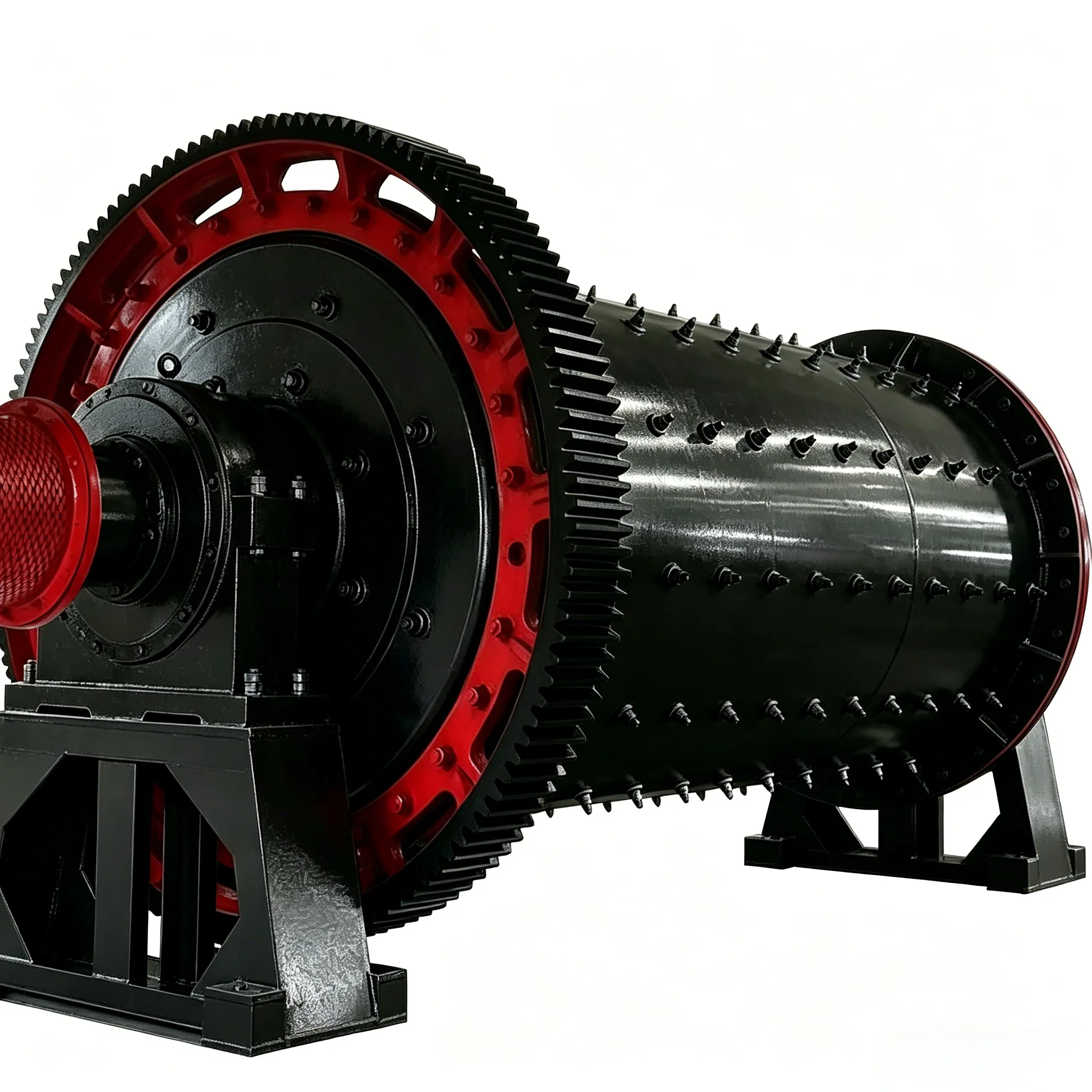
Grate Discharge Ball Mill
Construction of a Grate Discharge Ball Mill The difference between a grate…


Mill Liner Optimization Case Studies
Case 1 – Iron Ore Mine
In the production process of a certain iron ore mine, the ore supply source was transitioned from open‑pit to underground mining. As a result, the ore properties changed: the degree of weathering decreased, hardness increased, and the breakage rate declined. This led to a drop in efficiency of the AG mill. In order to maintain the required product fineness and improve the AG mill performance, steel balls were added to the mill, converting it to a SAG operation. This increased the capacity of the wet AG mill, ensured concentrate quality, and yielded good economic benefits. However, the introduction of steel balls altered the grinding environment that had existed in the original AG mill. In the middle and later stages of liner wear, the liners deformed and fractured under the impact of the balls. The central region of the liners experienced particularly severe wear. Originally, the liner service life was over 3,000 hours, but after adding steel balls it dropped by one‑third. This increased maintenance work and raised the failure rate. To address this situation, the structure and performance of the wear‑resistant liner components were optimised. The optimisation measures included: (1) improving the liner material to enhance its wear resistance, thereby extending service life; and (2) increasing liner thickness and modifying the cross‑sectional configuration to further improve service life.
Case 2 – TISCO Lan Mine (Metso SAG Mills)
TISCO Lan Mine operates three Metso SAG mills and has tried liners from different suppliers. Due to the high ore hardness, the liners frequently fractured and had short service lives, leading to frequent mill shutdowns that seriously affected production. Moreover, the liner life varied considerably between batches from some suppliers, making planned maintenance very difficult. Metso optimised its liner design for these mills in order to improve the operational conditions. In July 2016, Metso’s optimised multi‑angle wave‑profile shell liners were installed and commissioned in the grinding circuit at TISCO Lan Mine. Metso engineers conducted multiple on‑site data collections and analyses of the shell liner performance, and used simulation software to design the new liner structure. By changing the lifter angle and height of the shell liners, they optimised the material trajectory inside the SAG mill, reduced direct impacts between steel balls and liners, thereby lowering the liner wear rate and improving grinding efficiency. At the same time, Metso engineers modified the liner material to achieve an optimal balance of hardness and toughness, based on the mill’s operating conditions, thereby significantly enhancing the liners’ resistance to fracture and extending their service life.
In addition, Metso also provided optimised grate plates for TISCO. The new grate plates feature a modified discharge slot cross‑section, which reduces plugging, avoids cracking, and extends service life. The liner optimisation at TISCO Lan Mine improved the plant’s throughput and reduced operating costs.
Case 3 – Large Copper Mine (SAG Mill 10.37 m diameter × 5.19 m length)
A large domestic copper mine operates a SAG mill with dimensions 10.37 m in diameter by 5.19 m in length. The mill feed size is –300 mm, with closed‑circuit grinding using vibrating screens for classification. The grinding product size P80 = 194 μm, the throughput is 938 t/h, and the installed power is 2 × 5 MW. Before optimisation, the shell liners consisted of 66 rows, with bolt holes all located on the lifter bars. The lifter bars were arranged in a high‑low pattern: the high lifters were 305 mm high (including the base thickness), and the low lifters were 205 mm high (including the base). After 3.5 months of operation, the shell liners began to fracture. Two main fracture types were observed: one was longitudinal full‑length cracking, and the other was transverse fracture; a few cases showed corner chipping. The excessively high lifter bars and the too‑small face angle of the liners caused the steel balls to be lifted too high, so that they directly impacted the liners, leading to breakage and fracture. Discrete element modelling (DEM) using EDEM software was carried out to simulate the trajectories of the charge and steel balls inside the mill, confirming that ball impacts on the liners were occurring. The liner face angle was increased by 10°, and simulation results using liner modelling software indicated that at this new face angle, the balls no longer impacted the liners. The optimised liners have achieved good performance in field operation.


 English English
 Spanish
 Russian
 Arabic
 Swahili
 French
 Turkish
 Portuguese
 Korean
 Japanese
 German
 Italian