
Jaw Crushers
Types of Jaw Crushers Jaw crushers have been used in industrial production…

P1-B01
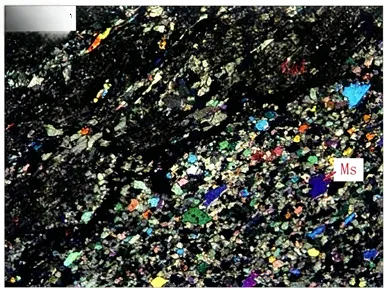
Granite. The rock is light grayish-white in color, with a fine-grained blastoporphyritic (fine-grained crystalloblastic) texture and massive structure. The main mineral constituents are quartz, followed by feldspar, with minor amounts of biotite and magnetite.
P1-B02
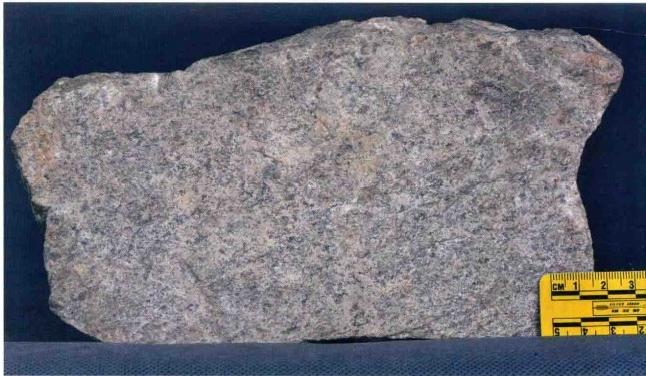
Feldspar-mica-quartz schist. The rock is light gray to gray in color, with a fine-grained lepidoblastic texture and schistose structure. The main mineral constituents are quartz, plagioclase, and biotite, with a minor amount of calcite.
The protolith is possibly argillaceous fine-grained feldspar-quartz sandstone.
P1-B03
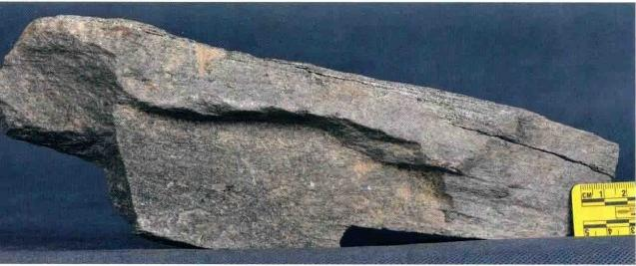
Two-mica quartz calcareous schist. The rock is grayish-white in color, with a granular-lepidoblastic texture, schistose structure, and banded structure. The main mineral constituents are calcite, quartz, biotite, and muscovite.
P1-B04
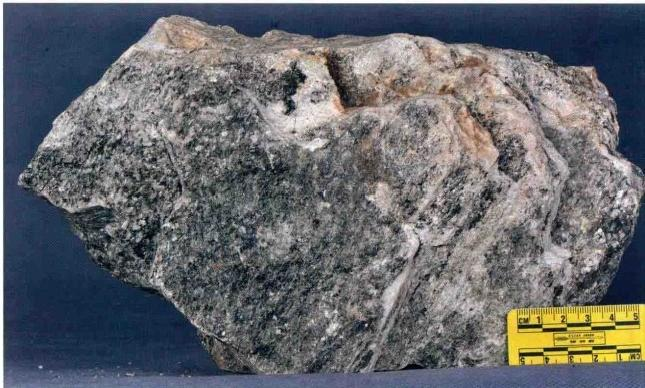
Muscovite calcareous schist. The rock is light grayish-green to grayish-white in color, with a fine-grained lepidoblastic texture and massive–banded structure. The main mineral constituents are calcite, dolomite, muscovite, and serpentine, with minor amounts of apatite and quartz.
When the rock is treated with nitric acid and then ammonium molybdate, a yellow coloration appears, indicating the presence of phosphate, although no distinct phosphate mineral is clearly observed. Its content is preliminarily estimated at about 5%.

P1-B05
Muscovite apatite rock. The rock is yellowish-gray to brownish-yellow in color, with a fine-grained lepidoblastic texture and banded structure. The specimen consists of two types of bands.
The gray biotite–apatite bands constitute 70%–80% of the rock, while the yellow phosphorite bands account for only 20%–30%. The average phosphate mineral content of the ore is 25%–30%. Both types of bands give a deep yellow coloration when the rock surface is treated with nitric acid and ammonium molybdate, indicating high phosphorus content.

P1-B06
Marble. The rock is light gray in color, with a fine-grained lepidoblastic texture and massive structure. The main mineral constituents are quartz and calcite, followed by biotite and muscovite, with trace amounts of pyrite.
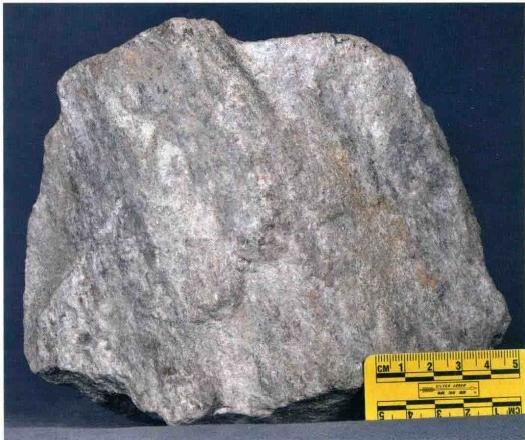
P1-B07
Dolomite marble. The rock is yellowish-white in color, with a fine to very fine-grained crystalloblastic texture and massive structure. The rock is composed almost entirely of fine to very fine-grained calcite and dolomite, white in color, with hardness lower than that of a knife blade. It effervesces slowly with dilute hydrochloric acid, while the rock powder effervesces vigorously with dilute hydrochloric acid; total carbonate content is greater than 95%.
The rock contains scattered very fine-grained muscovite and pyrite. Locally, brown to brownish-yellow streaks, bands, or patches are present, which contain brownish-yellow fine-grained speckled minerals.

P1-B08
Quartzite. The rock is white to brown in color, with a granular crystalloblastic to blastopsammitic (relict sandy) texture, massive structure, and locally vuggy (porous) structure. The main mineral constituent is quartz, with a minor amount of calcite.
The rock contains brown streaks or bands, within which fine brownish minerals are present. When the rock surface is treated with nitric acid and ammonium molybdate, it turns milky white, suggesting the possible presence of phosphate-bearing minerals.
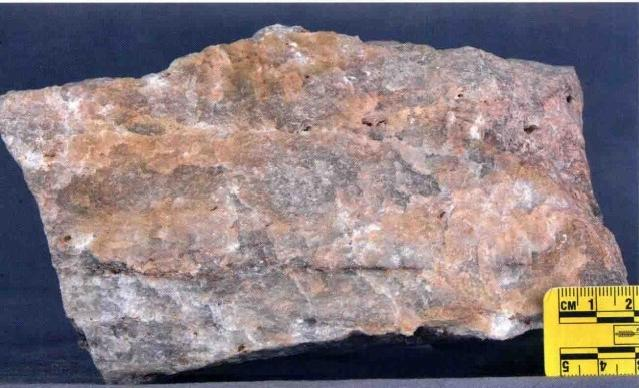
P1-B09
Apatite-mineralized dolomitic marble. The rock is milky white in color, with a fine-grained crystalloblastic texture and massive to banded structure. The main mineral constituents are calcite and dolomite, white to colorless, with hardness lower than that of a knife blade. It effervesces slowly with dilute hydrochloric acid, while the powder effervesces more strongly; dolomite predominates, and the total content of dolomite and calcite is greater than 95%. After weathering, it takes on a sugary (granular) appearance.
The rock contains apatite, which is brownish-yellow in color, mostly associated with carbonate veins, occurring as anhedral fine grains; content about 5%. When the rock surface is treated with nitric acid and ammonium molybdate powder, it shows a yellow precipitate of phosphomolybdate, indicating that the rock contains a relatively high amount of apatite.

P1-B10
Phosphorite. The rock is light gray to brownish-reddish gray in color, with a fine-grained crystalloblastic texture and massive structure. The main mineral constituents are dolomite and calcite, white in color, fine to very fine-grained, weakly effervescing with dilute hydrochloric acid; total carbonate content is greater than 80%. The protolith is probably calcareous dolomite or dolomite.
The rock commonly contains brownish-yellow apatite (phosphorite), occurring as amorphous massive bodies, distributed continuously or in spots. When concentrated nitric acid and ammonium molybdate powder are applied, a milky white color appears, possibly indicating collophane; content is about 40%.
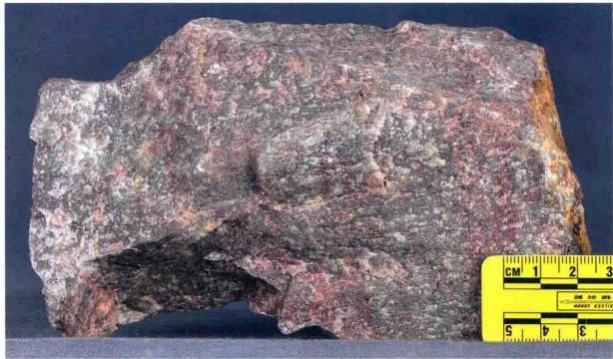
P1-B11
Biotite–epidote–quartz schist. The rock is dark gray (slightly greenish) in color, with a fine-grained crystalloblastic texture and schistose structure. The main mineral constituents are quartz and biotite, with minor amounts of epidote, garnet, and iron oxides.
The combined content of epidote and garnet is 15%–20%.
The rock contains sparsely disseminated hematite, with metallic luster; euhedral cubic crystals can be observed, but most are anhedral granular, partly occurring as anhedral granular aggregates. Most grain sizes are less than 1 mm, with some reaching 1–2 mm; content 1%–2%. Folding structures are visible in the specimen.

P1-B12
Dolomitic marble. The rock is light grayish-white in color, with a fine to very fine-grained crystalloblastic texture and massive structure. The rock is pure and composed almost entirely of dolomite and calcite, white in color, with low hardness. The rock effervesces weakly with dilute hydrochloric acid, while the powder effervesces vigorously; total carbonate content is greater than 95%. Dissolution vugs are developed in the fractures of the rock, and on the walls of the vugs, pure calcite and dolomite druses (crystal clusters) have grown.

P1-B13
Fine-grained phosphatic rock. The rock is white to light gray in color, with a micro-fine-grained crystalloblastic texture and streaked to banded structure. The mineral composition is predominantly fine to very fine-grained calcite, white in color, hardness lower than that of a knife blade; it effervesces vigorously with dilute hydrochloric acid; content >90%.
Fine muscovite veinlets are visible on fracture surfaces within the rock, and the veinlets contain fine-grained hematite. No phosphate minerals are visible to the naked eye in the rock; however, when the rock surface is treated with nitric acid and ammonium molybdate powder, a bright yellow color appears (possibly phosphomolybdate yellow), indicating that the rock contains phosphorus.

P1-B14
Fine-grained dolomitic apatite rock. The ore is pure white in color, with a fine-grained crystalloblastic texture and massive structure. The rock is strongly weathered. The main mineral constituent is fine sandy, granular calcite.
No phosphate minerals are visible in the rock; however, when the rock is treated with concentrated nitric acid and ammonium molybdate powder, a bright yellow color (phosphomolybdate yellow) appears, indicating that the rock contains phosphorus.
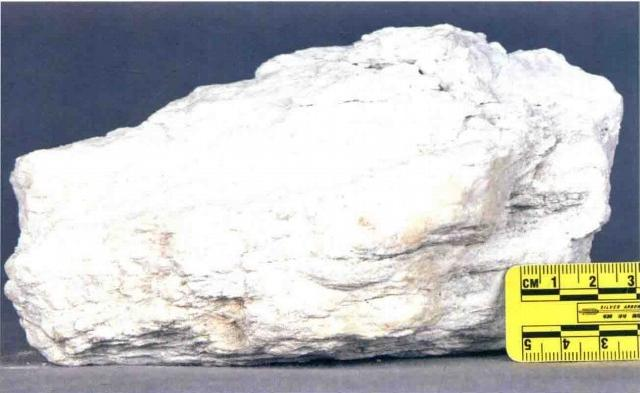
P1-B15
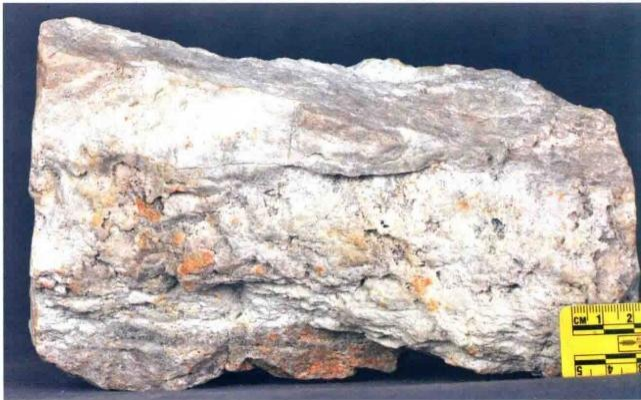
Fine-grained dolomitic apatite rock. The rock is grayish-white in color, with a medium-fine-grained crystalloblastic texture and banded structure. The main part of the rock is fine-grained marble, whose principal mineral constituents are calcite and dolomite, white in color, hardness lower than that of a knife blade; it effervesces vigorously with dilute hydrochloric acid; total carbonate content is greater than 70%.
The rock contains intercalations of dolomitic banded marble. The bands are mainly composed of dolomite, which effervesces weakly with dilute hydrochloric acid; the dolomite crystals are relatively coarse. The bands also contain fine-grained pyrite, with a yellow metallic luster, mostly limonitized on the surface. In these bands, the pyrite content can reach 10%–15%, and the dolomite content 15%–20%.
Within the marble, brownish-yellow apatite-bearing bands or patches are developed. Apatite is brown to brownish-yellow, anhedral fine-grained, with a content of about 5%.
When concentrated nitric acid and ammonium molybdate powder are applied to the marble, the dolomitic marble bands, and the apatite-bearing bands, all produce a bright yellow color (phosphomolybdate yellow), indicating that the rock is generally phosphorus-bearing.
P1-B16
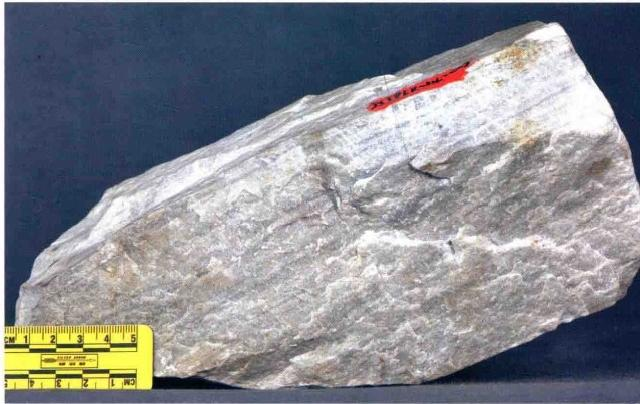
Fine-grained dolomitic apatite rock. The rock is white to light gray in color, with a fine-grained crystalloblastic texture and massive to vuggy structure. The main mineral constituent is calcite, white, fine to very fine-grained, with hardness lower than that of a knife blade; it effervesces vigorously with dilute hydrochloric acid; content >90%.
Minor amounts of quartz are also present, colorless and transparent, greasy luster, rounded granular. Muscovite: white to colorless, pearly luster, grain sizes all less than 1 mm; content 1%–2%.
No phosphate minerals are visible in the rock; however, when the rock is treated with concentrated nitric acid and ammonium molybdate powder, a bright yellow color appears, indicating that the rock contains phosphorus. The specific phosphate mineral species and its content need to be determined by petrographic and chemical analyses.
Small vugs are developed in the rock, generally small in size, about 1 mm in width and 2–5 mm in length; they are not filled, but contain small calcite grains. The vugs show preferred orientation, with a content of 3%–5%.
P1-B17
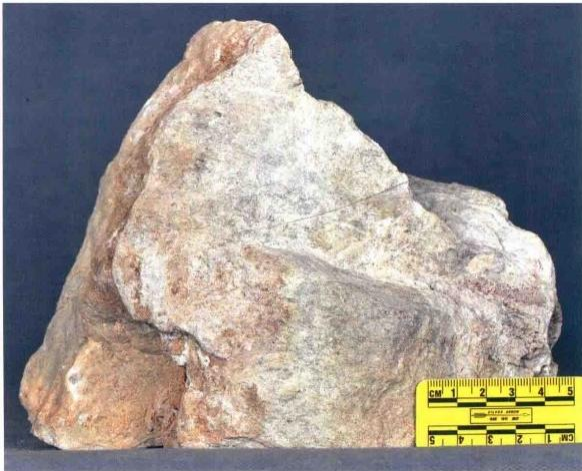
Fine-grained phosphatic rock. The rock is white to light grayish-white in color, with a micro-fine-grained crystalloblastic texture and vuggy structure. The main mineral constituent is very fine-grained calcite, white, with hardness lower than that of a knife blade; it effervesces vigorously with dilute hydrochloric acid; content >90%.
The rock contains a small amount of muscovite, white with pearly luster, euhedral flaky; content about 1%.
The rock is relatively fractured, with small dissolution vugs developed along structural fracture surfaces. On the walls of these vugs, botryoidal and crusty calcite (stalactitic) has formed, and occasionally secondary travertine with small calcite crystal clusters is present.
No phosphate minerals are visible to the naked eye in the rock; however, when the rock surface is treated with concentrated nitric acid and ammonium molybdate powder, a bright yellow color appears, indicating that the rock contains phosphorus.
P1-B18
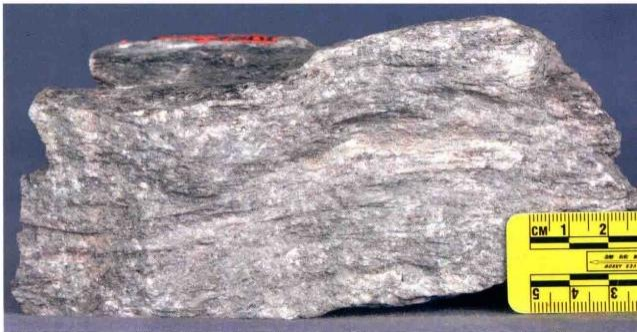
Mica schist. The rock is gray to light grayish-white in color, with a lepidoblastic texture and schistose structure. The main mineral constituents are calcite, dolomite, biotite, and muscovite, with minor pyrite.
P1-B19
Chlorite–epidote–albite schist. The rock is dark gray to grayish-black in color, with a medium-grained lepidoblastic texture, schistose structure, and massive structure. The main mineral constituents are quartz, followed by garnet and biotite, with minor amounts of chlorite and epidote.
P1-B20
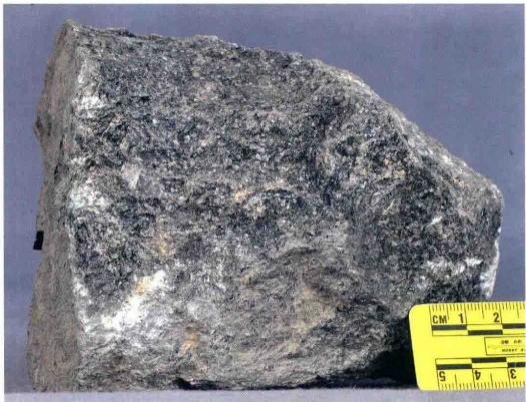
Fine-grained dolomitic phosphorite. The rock is light yellow to light brownish-yellow in color, with a medium-fine-grained crystalloblastic texture and laminated structure. The ore mineral is collophane (phosphorite), yellow to brownish-yellow, occurring as anhedral fine to very fine-grained to cryptocrystalline colloidal aggregates, distributed in laminae alternating with white calcite laminae; lamina thickness 1–3 mm; content 30%. When the ore surface is treated with concentrated nitric acid and ammonium molybdate powder, abundant bright yellow particles (possibly phosphomolybdate yellow) are formed.
The gangue minerals constitute the main body of the rock, which is marble, with calcite as the principal mineral. A small amount of calcite effervesces vigorously with dilute hydrochloric acid; it also yields a yellow color (phosphomolybdate yellow?) when treated with concentrated nitric acid and ammonium molybdate, indicating that it also contains phosphorus. Calcite occurs as laminated to banded layers, with band widths of 2–5 mm; content 65%–70%.
In addition, the rock has undergone leaching and dissolution, resulting in small vugs and cavities developed along the micro-bedding. The ore has a relatively high phosphorus content, constituting phosphate ore.
P1-B21
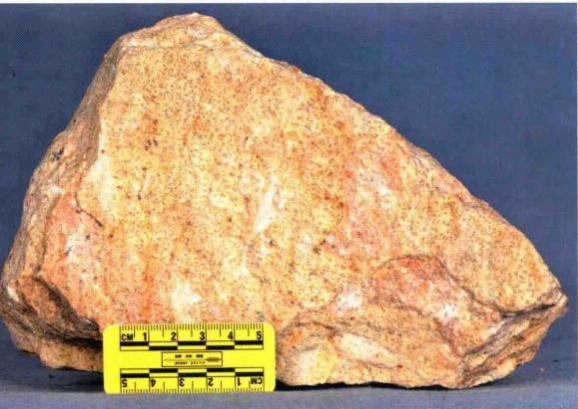
Pyrolusite ore. The rock is brownish-black in color, with predominantly colloidal to cryptocrystalline texture, and earthy to cellular (honeycomb) structure. The main ore mineral is pyrolusite, with limonite as the secondary mineral.

P1-B22
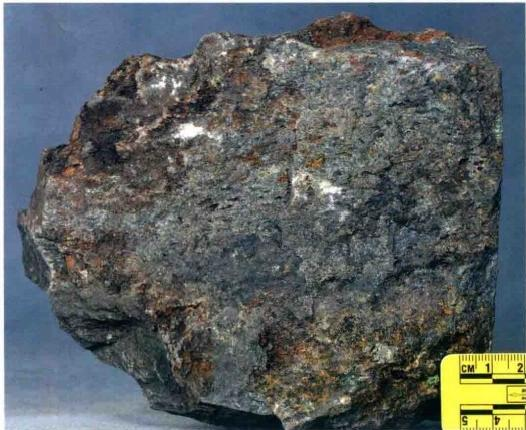
Manganese-iron ore. The rock is black to brownish-black in color, with fine-grained texture and locally relict reniform structure, massive to banded structure. The ore has relatively high density.
The main ore minerals are magnetite, hematite, pyrolusite, and secondary minerals limonite and malachite.
The primary metal sulfides are pyrite or chalcopyrite.
The gangue minerals are mainly colorless quartz, with minor amounts of feldspar and mica; total gangue content 30%.
P1-B23
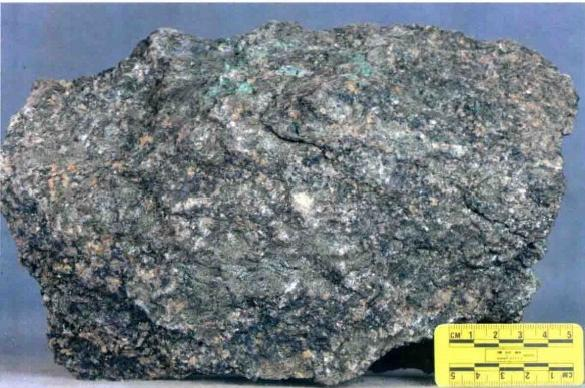
Copper-lead-zinc-bearing ore. The rock is yellowish-gray to yellowish-greenish-gray in color, with a medium-fine-grained texture and disseminated structure. The host rock has a medium-coarse-grained granitic texture, cataclastic structure, and massive structure.
The ore minerals are mainly galena, sphalerite, and secondary malachite.
Gangue minerals: The host rock is a medium-coarse-grained granitic rock, mainly composed of quartz, feldspar, biotite, and chlorite.

 English English
 Spanish
 Russian
 Arabic
 Swahili
 French
 Turkish
 Portuguese
 Korean
 Japanese
 German
 Italian