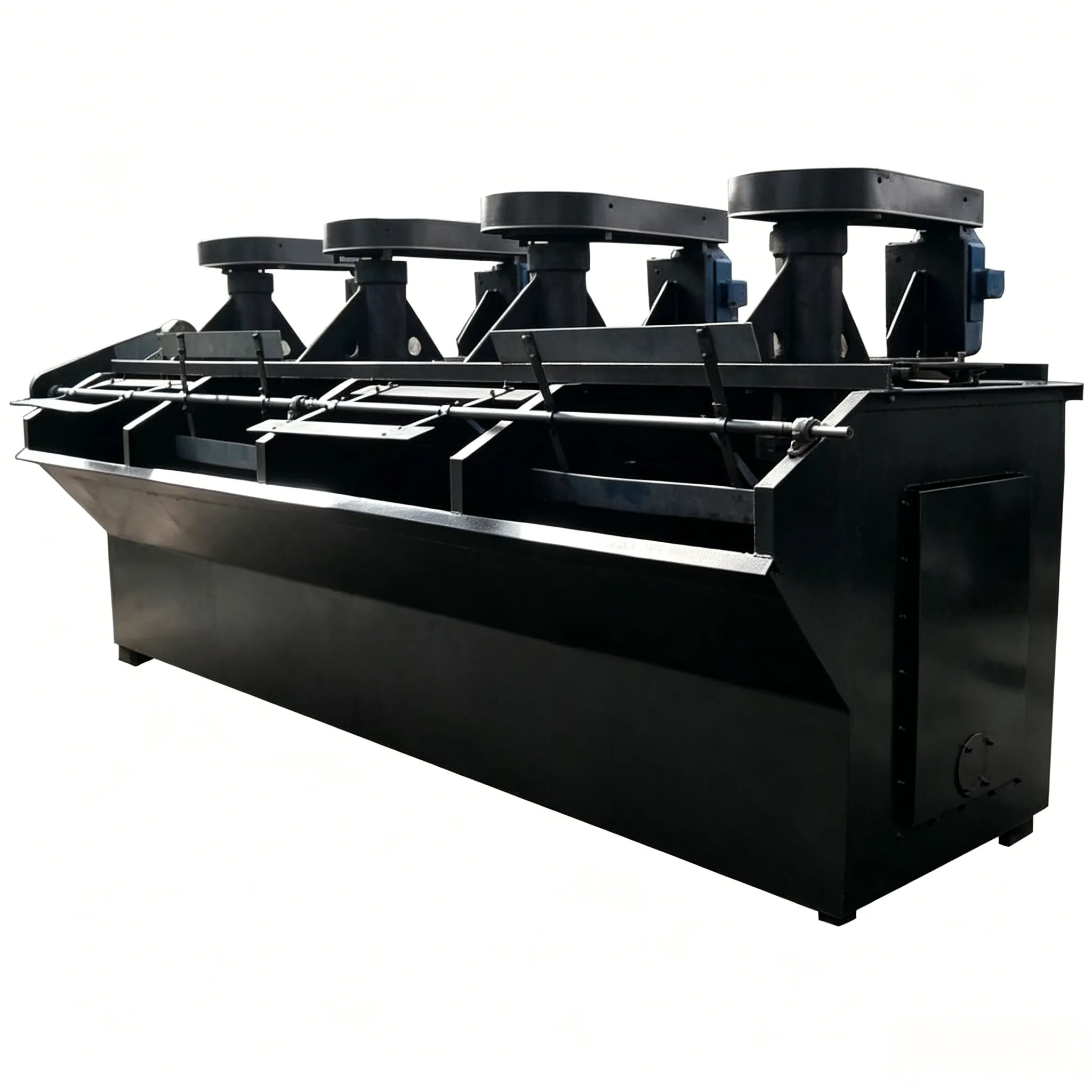
XJ Flotation Machine
XJ Flotation Machine (also known as Type A or XJK) This machine…


A Beneficiation Method for Scheelite–Wolframite Slimes
Technical Field
The present invention relates to a beneficiation method for recovering scheelite and wolframite minerals from scheelite–wolframite slimes.
Background Art
China is rich in tungsten resources, with both reserves and production ranking first in the world. At present, the key factor affecting the overall tungsten recovery in tungsten concentrators is the recovery of tungsten slimes. Chinese tungsten slimes are characterized by high yield, high metal content, and fine particle size. Generally, they account for 10–15% of the run‑of‑mine ore, with a WO₃ content of 0.15–0.5%, and the WO₃ metal in the slimes accounts for 15–20% of the total WO₃ in the run‑of‑mine ore. In the slimes, the WO₃ metal distribution in the –74 μm fraction is 85–99%, and that in the –30 μm fraction exceeds 60%, but gravity separation is poorly effective for the –30 μm fraction. According to statistics, the current recovery of scheelite–wolframite slimes in concentrators is only 20–30%, with a grade of 15–30%. Therefore, improving the beneficiation index of scheelite–wolframite slimes is the key to increasing the overall tungsten recovery.
At present, the beneficiation methods for scheelite–wolframite slimes include: classification–gravity–flotation–magnetic separation and all‑flotation.
The classification–gravity–flotation–magnetic separation method involves two‑stage hydrocyclone classification of the scheelite–wolframite slimes; the +30 μm fraction is subjected to roughing concentration using a slime shaking table, the table concentrate is subjected to flotation for desulphurization and then cleaned by shaking table to obtain a tungsten concentrate; the –30 μm fraction is subjected to roughing by centrifuge, cleaning by oscillating‑belt sluice, and after flotation desulphurization and magnetic separation, a low‑grade tungsten concentrate is obtained. The disadvantage of this method is that the tungsten products do not achieve separation of wolframite and scheelite, and the low‑grade tungsten product contains both wolframite and scheelite. This method not only has a complex flowsheet, many types of equipment, high precision requirements, and poor adaptability in industrial production, but also yields poor recovery of scheelite–wolframite slimes.
The all‑flotation method directly floats the scheelite–wolframite slimes. After removing sulfide minerals, bulk flotation of scheelite and wolframite is carried out. The bulk concentrate is then subjected to the Petrov process for cleaning and separation to obtain a scheelite concentrate and a wolframite concentrate. This method has a simple flowsheet, but because the tungsten metal in the –30 μm fraction accounts for over 60% of the slimes, and the slimes contain 30–45% of easily floatable gangue minerals such as mica, calcite, fluorite, and kaolinite, the bulk flotation suffers from a large circulating load, low concentrate grade, large cleaning feed volume, and high reagent consumption.
Chinese Patent No. 200410051961.1 discloses a beneficiation method for scheelite–wolframite ores. In that method, run‑of‑mine ore typically containing 0.2–2.0% WO₃ with a scheelite‑to‑wolframite ratio of 1:9 to 9:1 is crushed and ground, then subjected to low‑intensity magnetic separation to remove iron minerals and flotation to remove sulfide minerals. To the tailings, certain amounts of benzohydroxamic acid and sulfated oleic acid soap or tall oil soap are added as collectors, and sodium silicate and aluminum sulfate as combined regulators, for bulk flotation of scheelite and wolframite. The bulk concentrate is subjected to heated cleaning to obtain a scheelite concentrate, and the heated cleaning tailings are processed by shaking table gravity separation and tungsten slime flotation to obtain a wolframite concentrate and a tungsten slime concentrate, respectively. This method is abbreviated as the GY method. When this method is used for bulk flotation of scheelite and wolframite, the bulk concentrate has a similar WO₃ content but relatively low recovery.
Summary of the Invention
The object of the present invention is to provide a beneficiation method that achieves good separation of scheelite–wolframite slimes, high grade and recovery of the bulk concentrate, and low reagent cost.
The beneficiation method of the present invention sequentially comprises the following steps:
The features of the present invention are: the flowsheet for recovering scheelite–wolframite slimes is simple, the bulk flotation process is stable, tungsten recovery is high, reagent cost is low, the reagents used are environmentally friendly, and the tailings water can be simply treated with lime to meet discharge requirements.
Brief Description of the Drawing
Figure 1 is a flowsheet of the beneficiation method for scheelite–wolframite slimes according to the present invention.

Detailed Description of the Embodiments
Scheelite–wolframite slimes containing WO₃ 0.10–0.50%, molybdenum 0.013–0.50%, bismuth 0.03–0.60%, with a WO₃ metal distribution in the –30 μm fraction of ≥60%, are subjected to gravity desliming. The gravity desliming consists of three stages: one roughing, one cleaning, and one scavenging. The centrifuge rougher concentrate enters the centrifuge cleaner; the centrifuge cleaner tailings are returned to the centrifuge rougher; the centrifuge rougher tailings enter the shaking table scavenger. The shaking table scavenger concentrate is combined with the centrifuge cleaner concentrate to form the gravity concentrate, which has WO₃ ≥1.5% and a recovery ≥80%. The gravity concentrate is thickened in a thickener to a solids concentration of 30–45% and then enters sulfide flotation to obtain a sulfur concentrate and a sulfide flotation tailing. Based on each tonne of slime feed, to the sulfide flotation tailing are added regulators sodium carbonate 100–500 g, sodium silicate 500–5000 g, aluminum sulfate 100–2000 g, and lead nitrate 50–1000 g, with stirring for 1–10 minutes; then collector sulfated oleic acid soap 50–500 g is added, with stirring for 1–10 minutes. After one stage of roughing, 2–4 stages of cleaning, and 2–3 stages of scavenging, a scheelite–wolframite bulk flotation concentrate with WO₃ 8–20% and a bulk flotation tailing are obtained. 50–85% of the sulfated oleic acid soap is used in roughing, and 15–50% in scavenging. The bulk flotation concentrate is subjected to heated cleaning to obtain a scheelite concentrate, and the heated cleaning tailings are processed by shaking table gravity separation to obtain a wolframite concentrate.
Example 1
The scheelite–wolframite slime contained WO₃ 0.37%, with a WO₃ metal distribution in the –30 μm fraction of 67%, and a scheelite‑to‑wolframite ratio of 6:4. The slime was deslimed by gravity, and the gravity concentrate was thickened to 35% solids and then subjected to sulfide flotation. To the sulfide flotation tailing, regulators sodium carbonate, sodium silicate, aluminum sulfate, and lead nitrate were added according to the reagent scheme in Table 1, with stirring for 8 minutes; then collector sulfated oleic acid soap was added and stirred for 6 minutes. Bulk flotation was carried out with one roughing, two cleanings, and two scavengings, yielding a bulk flotation concentrate containing WO₃ 8.29% with a recovery of 75.58%.
Example 2
The scheelite–wolframite slime contained WO₃ 0.3%, with a WO₃ metal distribution in the –30 μm fraction of 73%, and a scheelite‑to‑wolframite ratio of 6:4. The slime was deslimed by gravity, and the gravity concentrate was thickened to 33% solids and then subjected to sulfide flotation. To the sulfide flotation tailing, regulators sodium carbonate, sodium silicate, aluminum sulfate, and lead nitrate were added according to the reagent scheme in Table 1, with stirring for 6 minutes; then collector sulfated oleic acid soap was added and stirred for 7 minutes. Bulk flotation was carried out with one roughing, three cleanings, and two scavengings, yielding a bulk flotation concentrate containing WO₃ 15.13% with a recovery of 77.59%.
Example 3
The scheelite–wolframite slime contained WO₃ 0.21%, with a WO₃ metal distribution in the –30 μm fraction of 81%, and a scheelite‑to‑wolframite ratio of 5:4. The slime was first deslimed by gravity, and the gravity concentrate was thickened to 30% solids and then subjected to sulfide flotation. To the sulfide flotation tailing, regulators sodium carbonate, sodium silicate, aluminum sulfate, and lead nitrate were added according to the reagent scheme in Table 1, with stirring for 10 minutes; then collector sulfated oleic acid soap was added and stirred for 5 minutes. Bulk flotation was carried out with one roughing, two scavengings, and two cleanings, yielding a bulk flotation concentrate containing WO₃ 10.63% with a recovery of 73.60%.
As can be seen from Table 1, for three different scheelite–wolframite slime samples containing 0.10–0.50% WO₃, with a WO₃ metal distribution in the –30 μm fraction of ≥60% and a scheelite‑to‑wolframite ratio of 5:4 to 6:4, using the method of the present invention, a bulk flotation concentrate with WO₃ 8–20% and a recovery ≥70% was obtained.
When the scheelite–wolframite slimes were deslimed by gravity, and the gravity concentrate was thickened to 30–33% solids and then subjected to sulfide flotation, and the GY method was applied to the sulfide flotation tailing for bulk flotation, a bulk flotation concentrate with WO₃ 8–20% was obtained but with a recovery of only 50–60%. In the all‑flotation method, the scheelite–wolframite slimes were directly subjected to sulfide flotation, and then the sulfide flotation tailing was subjected to bulk flotation using the reagent scheme of Example 1 (Table 1) with sodium carbonate, sodium silicate, aluminum sulfate, and lead nitrate added and stirred for 10 minutes, followed by collector addition and stirring for 5 minutes. The resulting bulk concentrate contained only about WO₃ 2.73% with a recovery of 79.1%.
The present invention is applicable to scheelite–wolframite slimes containing 0.10–0.50% WO₃ with a WO₃ metal distribution in the –30 μm fraction of ≥60%.
Reagent schemes and test results for Examples 1 to 3
| Implementation example | Dosage of reagent (g/ton. fine mud feed) | Test results | |||||||||||
| Black and white tungsten roughing | Scan one | Scan two | Selected 1 | Selected 2 | Black and white tungsten mixed flotation concentrate | ||||||||
| Sodium carbonate | Water glass | Aluminum sulfate | lead nitrate | Sulfation Oleic soap | Sulfation Oleic soap | Water glass | Aluminum sulfate | Water glass | Aluminum sulfate | grade(%WO ₃ ) | Recovery rate(%) | ||
| 1 | 300 | 600 | 200 | 90 | 90 | 45 | 24 | 300 | 100 | 8.29 | 75.58 | ||
| 2 | 400 | 700 | 3500 | 100 | 100 | 50 | 30 | 300 | 100 | 300 | 100 | 15.13 | 77.59 |
| 3 | 300 | 1200 | 400 | 90 | 125 | 50 | 25 | 500 | 177 | 300 | 100 | 10.63 | 73.60 |
No reagents are added in the second cleaning stage of Example 1;
no reagents are added in the third cleaning stage of Example 2.
 English English
 Spanish
 Russian
 Arabic
 Swahili
 French
 Turkish
 Portuguese
 Korean
 Japanese
 German
 Italian