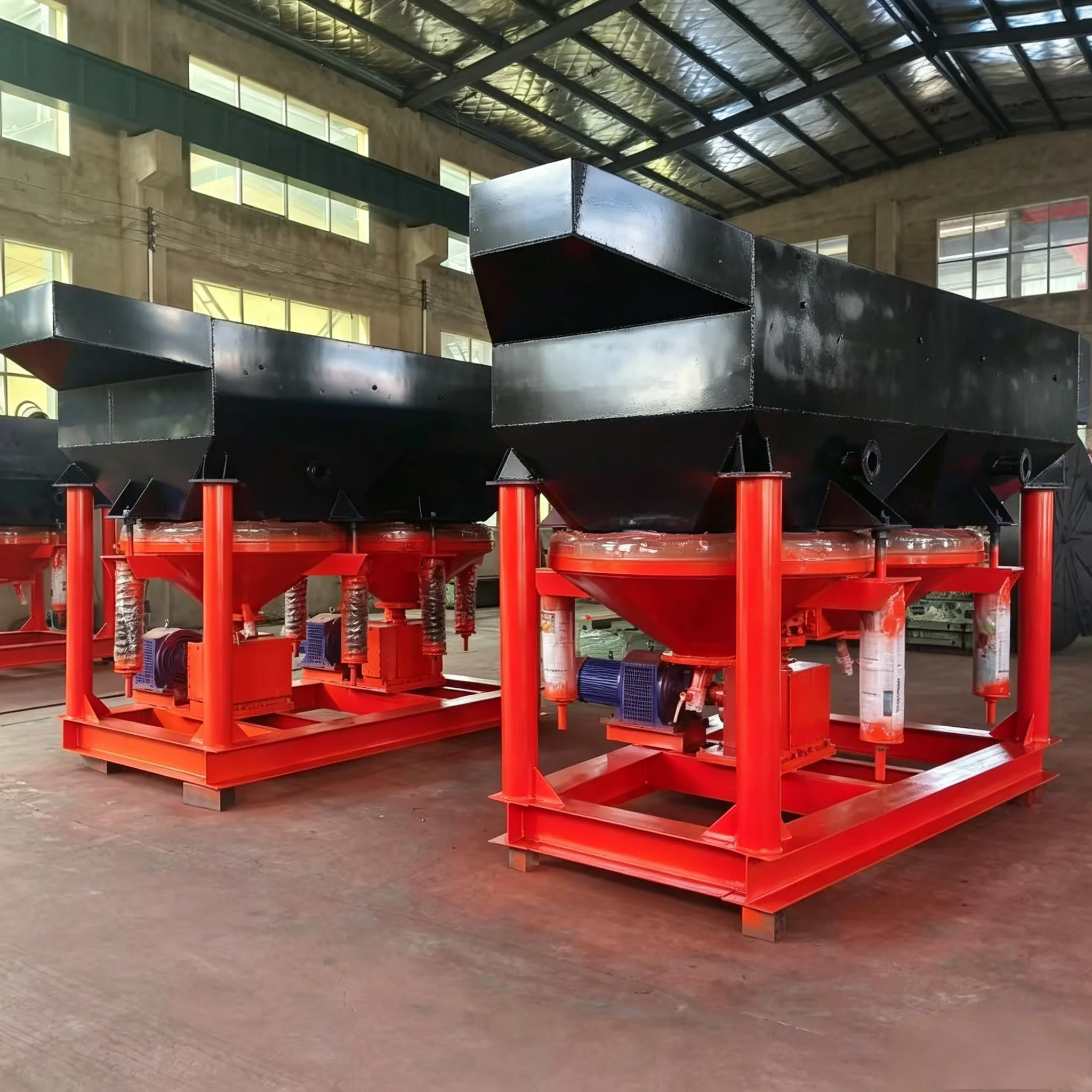
Jig machine
Jig – High-Efficiency Gravity Concentrator Product Overview A jig is a gravity…


Carbonate – Fluorite Ore Flotation Separation Method
The present invention belongs to the field of mineral separation, and in particular relates to a flotation separation process and reagents for fluorite ores with high carbonate content.
In the fluorite ore beneficiation industry, the separation of fluorite from carbonate minerals such as calcite has long been a difficult problem due to their similar floatability. East German Patent No. 157446 discloses a method using Cordesin O (N‑methyl acylamino carboxylic acid) as a collector for separating fluorite and calcite, obtaining a fluorite concentrate with CaF₂ 97.3% and CaCO₃ 1.1%. This method was also reported in detail at the 15th International Mineral Processing Congress. Its characteristics are: a simple flowsheet (one roughing, three cleaning stages), flotation in a weakly alkaline medium (pH = 8), and conventional implementation. However, when the calcite content in the raw ore is higher than the fluorite content, its adaptability is poor, and this process also imposes strict requirements on grinding fineness.
The object of the present invention is to select effective depressants for calcite and other impurities, and to adopt an enhanced depression process, thereby achieving high‑purity separation of carbonate – fluorite ores—particularly ores in which the calcite content is higher than the fluorite content—using a simple flotation flowsheet and conventional process conditions.
The hydrolysis products of sodium silicate, namely H₄SiO₄, H₂SiO₃, HSiO₃⁻ and colloidal SiO₂, exhibit depressive effects on calcite, quartz and other minerals, while also enhancing the activity of the flotation froth. When sodium silicate is acidified with acid, the optimisation of these product forms and the intensification of their action mechanism are accelerated. Utilising this special reagent property of acidified sodium silicate, a flotation process employing high reagent dosages and multi‑stage conditioning for depression is used to recover fluorite from calcite‑associated fluorite ores.
The flotation flowsheet adopted by the present invention comprises one stage of roughing and four stages of cleaning. The main process conditions are: feed ore ground to 65% passing 200 mesh (40 μm 40%), pulp density approximately 30%, flotation temperature 20–30°C, and flotation pulp pH = 6.5 ± (naturally formed after the addition of acidified sodium silicate).
The collector is oleic acid or linoleic acid, the dosage of which is proportional to the fluorite content in the ore. Depending on the fluorite content of the ore, the collector dosage ranges from 100 to 800 g/t, increasing with higher fluorite grades.
The depressant – acidified sodium silicate – is prepared from commercial sodium silicate (modulus m = 2.0–3.0), which is diluted and then acidified with acid (sulphuric acid or hydrochloric acid). The acidification ratio is sodium silicate : acid = 1 : 0.1–2.0. After acidification, the total concentration of the sodium silicate solution is 0.1–10%, characterised by being clear and free of flocculent precipitate. The dosage, depending on the content of calcite and other impurities in the ore, is added in multiple stages at the roughing, first cleaning, second cleaning, etc., with each addition at 1000 g/t.
The process and reagents of the present invention can also replace the alkaline‑medium separation of quartz – fluorite ores, as well as the separation of carbonate – fluorite ores using sodium silicate + polyvalent metal salt mixed formulations. It avoids the discharge of high‑alkalinity pulp or wastewater containing polyvalent metal ions, as well as the use of polymeric depressants, thereby contributing significantly to the reduction of environmental pollution.
Using the present invention, fluorite ores in which the calcite content is as high as 75% can be separated, with fluorite flotation recoveries of 70–95%, and the concentrate quality can reach first‑grade or special‑grade products.
The following are several examples using the present invention:
Example 1: Raw ore: CaF₂ 69.82%, CaCO₃ 5.60%. Reagent dosages: oleic acid 600 g/t, acidified sodium silicate 2000 g/t (added at the roughing and first cleaning stages respectively). Concentrate produced: CaF₂ 99.20%, CaCO₃ 0.63%, with a fluorite recovery of 95.76%.
Example 2: Raw ore: CaF₂ 41.07%, CaCO₃ 43.74%. Reagent dosages: oleic acid 500 g/t, acidified sodium silicate 3000 g/t (added at the roughing, first cleaning and second cleaning stages respectively). Concentrate produced: CaF₂ 99.20%, CaCO₃ 0.66%, with a fluorite recovery of 85.45%.
Example 3: Raw ore: CaF₂ 18.10%, CaCO₃ 74.40%. Reagent dosages: oleic acid 250 g/t, acidified sodium silicate 4000 g/t (added at the roughing, first cleaning, second cleaning and third cleaning stages respectively). Concentrate produced: CaF₂ 99.06%, CaCO₃ 0.77%, with a fluorite recovery of 73.30%. If a concentrate with CaF₂ ≥ 97% is produced, the fluorite recovery reaches 84%.
 English English
 Spanish
 Russian
 Arabic
 Swahili
 French
 Turkish
 Portuguese
 Korean
 Japanese
 German
 Italian