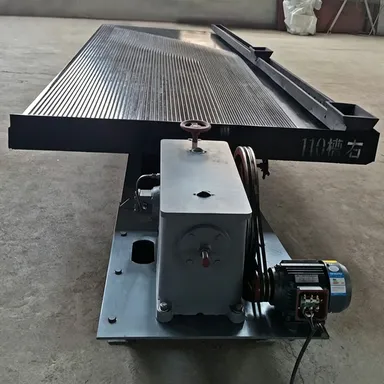
Shaking Table
Shaking Table – High-Precision Gravity Concentrator Product Overview The shaking table (also…

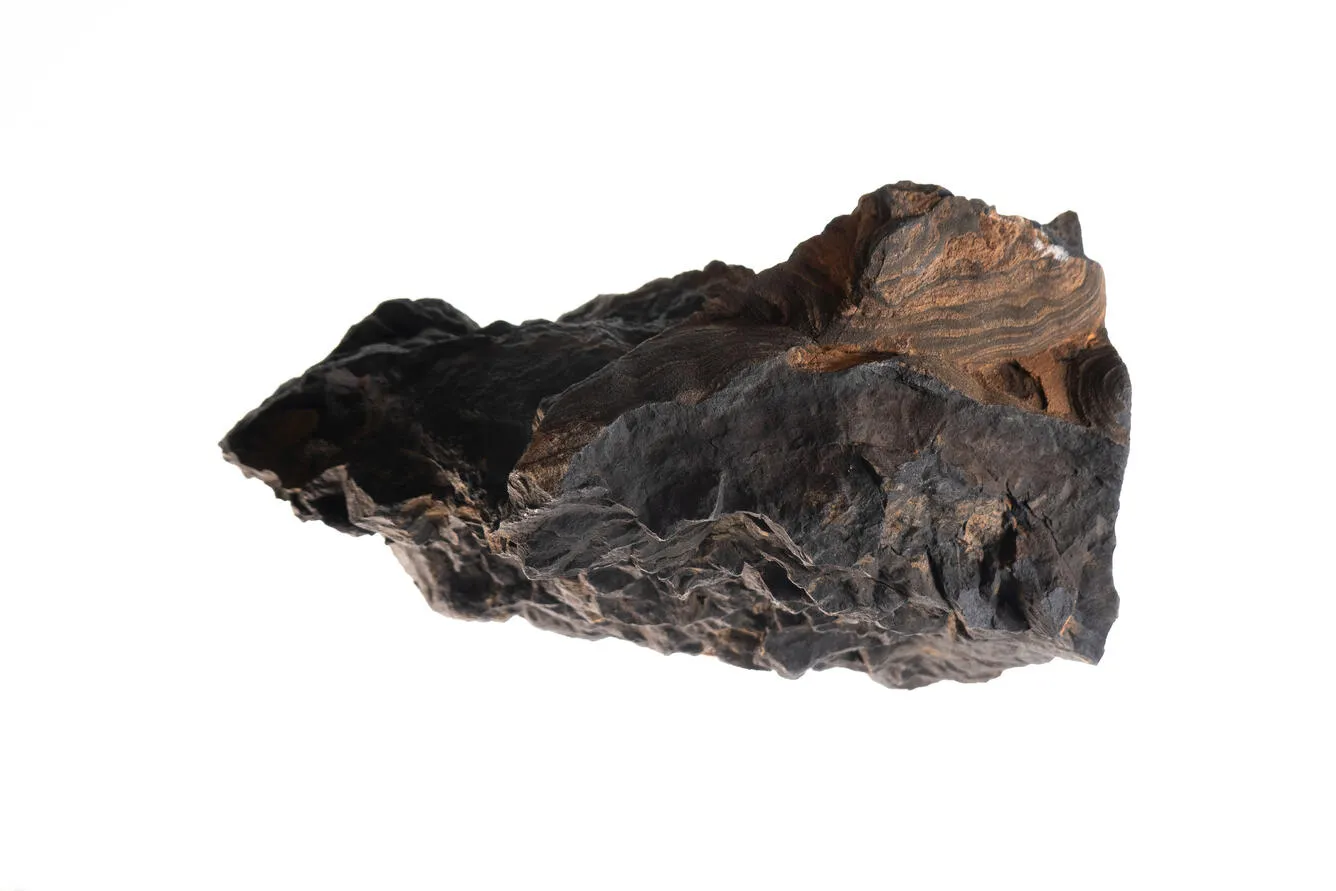
Sample Mn1‑B01
Fine‑grained calcareous dolomite.
The fresh surface of the rock is light grey to light yellowish‑grey, while the weathered surface is yellowish‑white, brownish‑yellow, or earthy‑yellow. It has a fine‑grained to silt‑sized crystalline texture and a massive structure. The main minerals are calcite and dolomite, with minor impurities.
Dolomite and calcite are white to colourless, with a vitreous lustre and a hardness less than that of a knife (i.e. < ~5.5 on Mohs scale). They effervesce readily with dilute hydrochloric acid. The rock is largely composed of fine to silt‑sized microcrystals, with grain sizes mostly around 0.2 mm, some even finer; under a magnifying glass, individual mineral grains are not distinguishable. These carbonate minerals account for more than 75% of the rock. Dolomite and calcite are difficult to distinguish macroscopically. Along rock fractures, thin films of brownish‑yellow ferruginous‑calcitic material are infilled.
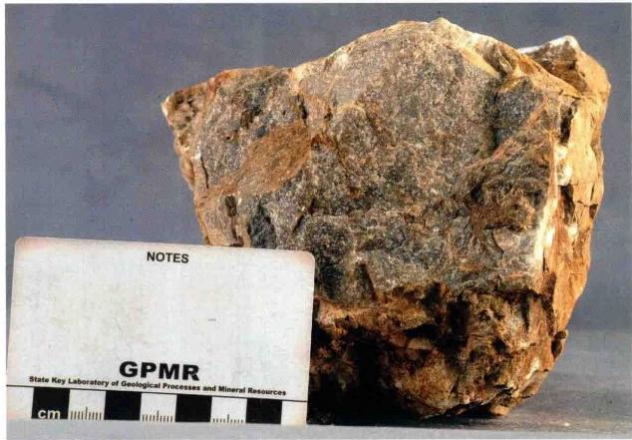
Mn1‑B02
Micritic calcareous dolomite.
The fresh surface of the rock is pale grayish‑green to light grayish‑green; the weathered surface is earthy yellow. It has a silty to micritic texture and a thin‑bedded to fine‑laminated structure. The main mineral constituents are calcite and dolomite, with minor argillaceous material.
Calcite and dolomite are white to colourless, fine‑grained, mostly silty to micritic, and have low hardness. They effervesce with dilute hydrochloric acid, and the powder effervesces vigorously. Their content is about 80%.
The argillaceous material is yellow to earthy yellow, occurring as fine laminae with individual lamina thickness ranging from 0.1 to 1 mm. After weathering, it becomes an earthy yellow powder. Its content is about 20%.
Because the grains of calcite and dolomite are very fine, it is difficult to distinguish them with the naked eye or even under a magnifying glass.
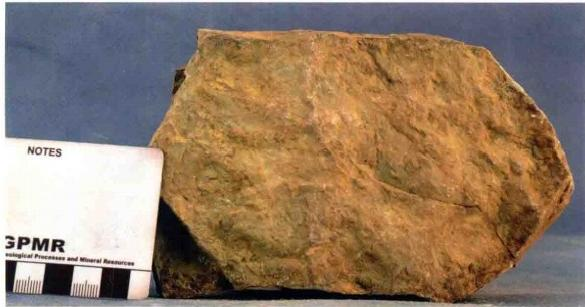
Sample Mn1‑B03
Manganese‑bearing detrital dolomitic limestone.
The rock is purplish‑red to brownish‑red in colour, with a fine‑ to silt‑sized crystalline texture and a massive structure. The main mineral components are calcite and dolomite, with minor argillaceous material and possibly manganese‑bearing material (?).
Calcite is white to colourless, with a vitreous lustre and a hardness less than that of a knife (i.e. < ~5.5 Mohs). It reacts vigorously with dilute hydrochloric acid and accounts for approximately 90% of the rock. The argillaceous and manganese‑bearing materials are very fine‑grained and indistinguishable with the naked eye.
Dolomite is white to colourless, fine‑grained, and constitutes about 8%–10% of the rock.
Small calcite veins (2–3 mm wide) are visible in the rock; they effervesce with acid and have irregular extensions. Black mineral grains occur in the central parts or along the veins, but because of their fine grain size, they are difficult to identify.
Sample Mn1‑B04
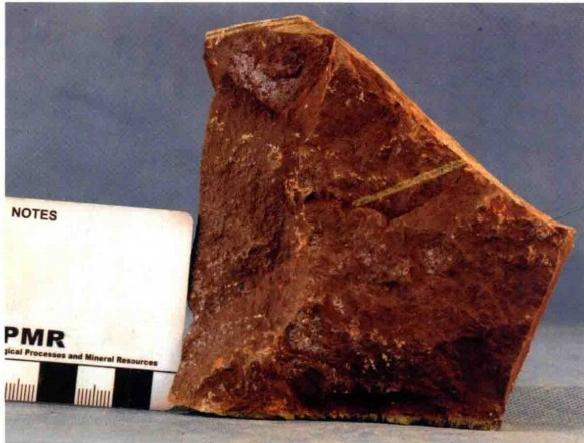
Chert‑band‑bearing calcareous dolomite.
The fresh surface of the rock is yellowish‑grey to grey, while the weathered surface is light earthy‑yellow. It has a fine crystalline texture and a massive to finely laminated structure. The principal minerals are calcite and dolomite. Because the mineral grains are very fine (all less than 0.2 mm), the two minerals are difficult to distinguish from each other. The fresh rock effervesces only weakly with dilute hydrochloric acid, but the powdered rock effervesces more vigorously.
A lenticular chert band, 1–2 cm wide, is developed along the bedding in the specimen. The band consists of microcrystalline opal, is grey, translucent, and has a high hardness. In addition, the weathered surface displays knife‑cut dissolution grooves (karren), which are a characteristic weathering feature of dolomitic rocks.
Sample Mn1‑B05
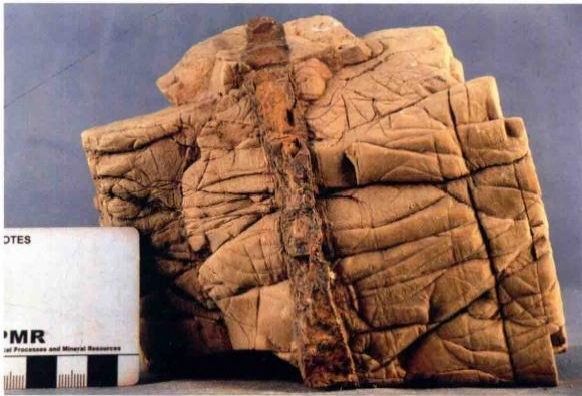
Purplish‑red argillaceous calcareous breccia.
The rock is purplish‑red to brownish‑red to brown in colour, with a micritic to sparry texture and a massive to brecciated structure. The main mineral component is calcite, with subordinate argillaceous material.
The clasts in the rock vary considerably in size, ranging from 1 to 5 mm, and exhibit variable roundness – from angular to subangular to subrounded. The composition of the clasts is essentially the same as that of the cement, both being dominated by calcite, which effervesces vigorously with dilute hydrochloric acid; argillaceous material is secondary and compositionally heterogeneous. In some places the carbonate (calcite) content is higher, while in others the argillaceous content predominates, without any clear regularity.
Because the clasts and cement have broadly similar compositions, and because the rock may have undergone slight post‑diagenetic metamorphism, the boundary between clasts and cement is sometimes indistinct.

Sample Mn1‑B06
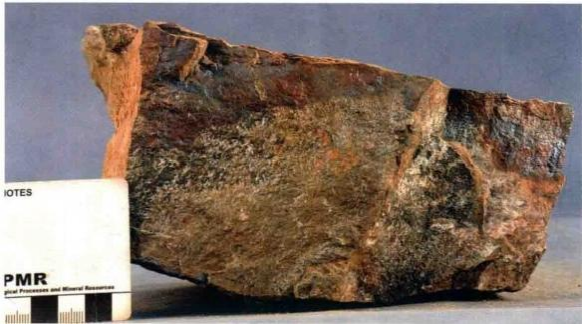
Hematite‑bearing microcrystalline calcareous dolomite.
The rock is brownish‑yellow to yellowish‑grey, with a microcrystalline to fine crystalline texture and a massive structure. It is composed almost entirely of microcrystalline calcite and dolomite, which are brownish‑yellow to white in colour, have a vitreous lustre, a hardness less than that of a knife (i.e. < ~5.5 Mohs), and effervesce vigorously with dilute hydrochloric acid.
In addition, sparsely distributed dark brown irregular patches are visible in the rock. These patches are probably composed of cryptocrystalline hematite, range in size from 2 mm to 1 cm, and show a faint bedding‑parallel or oriented distribution. The streak (powder) of the hematite is cherry‑red.
Sample Mn1‑B07
Ferruginous‑manganiferous argillaceous siltstone.
The rock is greyish‑black to brownish‑black in colour, with a silty to argillaceous texture and a thin‑bedded to laminated structure. The mineral composition is dominated by fine quartz silt, with subordinate argillaceous material.
Quartz occurs as silt‑sized grains, which are not distinguishable with the naked eye. It has a high hardness (scratches with difficulty with a knife) and gives a sandy feel when handled. It constitutes 60%–70% of the rock and commonly forms thin beds 0.5–3 cm thick.
The argillaceous material has indistinguishable grain sizes, with a microcrystalline to micritic texture. Its colour varies from reddish to dark greenish. It accounts for 20%–30% of the rock and commonly forms fine laminae 1–5 mm thick.
The quartz silt and argillaceous material are relatively concentrated in separate layers, giving rise to a thin‑bedded or laminated structure with parallel, straight bedding planes. Small fractures perpendicular to bedding are developed in the rock, mainly within the quartz siltstone beds. Most of these fractures are filled with quartz veinlets about 1 mm wide, but they generally do not cut across the bedding.

Sample Mn1‑B08
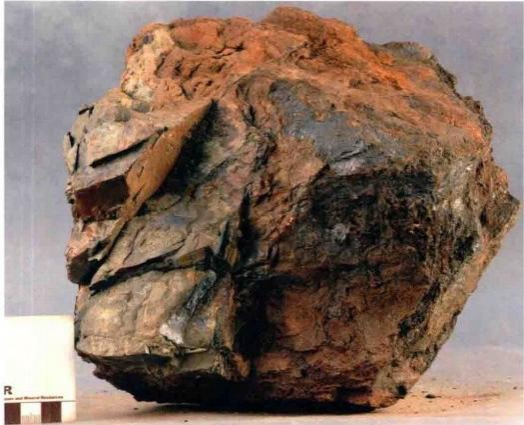
Purplish‑black manganese ore.
The ore is dark brown to brownish‑black in colour, with a fine to microcrystalline texture and a cellular, vuggy structure. The ore minerals are dominated by pyrolusite, with subordinate psilomelane, manganite, and others, totalling more than 25% of the rock.
The gangue minerals include silt, argillaceous material, calcite, and minor quartz, with a total content exceeding 70%.
This ore is an oxidised ore. The host rocks are silty mudstone and manganiferous microcrystalline limestone. Cellular and vuggy structures are well developed in the ore, and these cavities are commonly infilled with earthy pyrolusite.
Sample Mn1‑B09
Argillaceous siltstone.
The rock is brownish‑grey in colour, with a silty to argillaceous texture and a thin‑bedded to laminated structure. The mineral composition is dominated by fine quartz silt, possibly with minor feldspar, largely composed of fine felsic grains less than 0.1 mm in size. It has a high hardness and cannot be scratched by a knife, accounting for 70%–75% of the rock.
Subordinate microcrystalline argillaceous components occur as laminae less than 1 mm thick within the siltstone, constituting 20%–25% of the rock.
Sparse hair‑like quartz veinlets (white to colourless, about 1 mm wide, with irregular extensions) are infilled along the laminae within the rock.
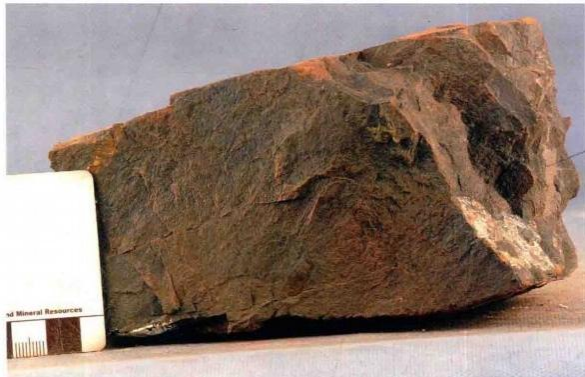
Sample Mn1‑B10
Massive dense manganese ore.
The rock is brownish‑black in colour, with a fine‑grained to microcrystalline texture and a massive, dense structure. The ore minerals are mainly manganite and psilomelane, with minor pyrolusite.
The above manganese minerals account for more than 40% of the rock (the ore body is relatively large). The gangue minerals include microcrystalline calcite, fine silt, and argillaceous components, constituting less than 60% of the rock. Irregularly spaced quartz veinlets are also developed in the ore.

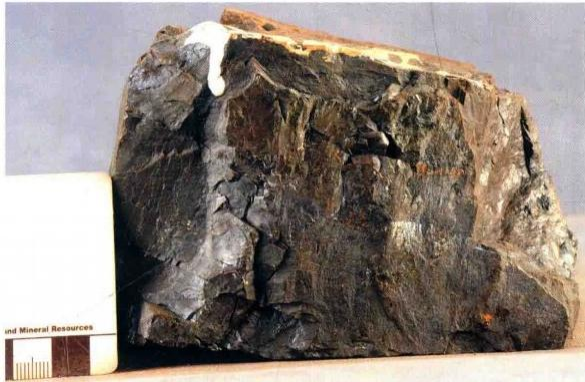
Sample Mn1‑B11
Massive dense manganese ore.
The ore is brownish‑grey to dark steel‑grey in colour, with a cryptocrystalline to microcrystalline texture and a massive, dense structure. The ore minerals are mainly manganite and psilomelane, with trace pyrolusite. The two are closely intergrown, both occurring as cryptocrystalline masses, brownish‑black to dark steel‑grey, with a submetallic to metallic lustre, hardness slightly greater than that of a knife, and a brown streak. They account for more than 50% of the rock.
The gangue minerals consist of silt, microcrystalline calcite, and argillaceous material, totalling less than 50%. In the specimen, local bands of siltstone or argillaceous siltstone, about 2 cm thick, are present; these bands represent interbeds (waste rock) within the ore body. In addition, the ore contains microfine quartz veinlets infilled along bedding planes.
Sample Mn1‑B12
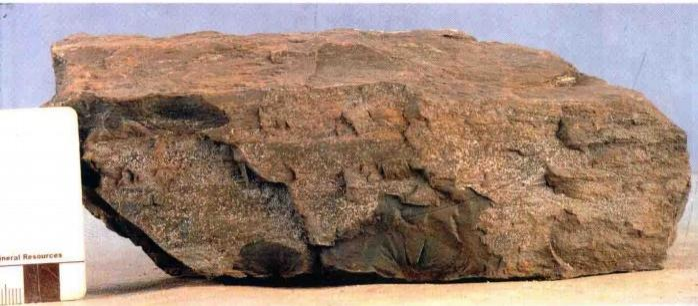
Argillaceous siltstone.
The rock is brownish‑black in colour, with a fine to very fine‑grained silty texture and a laminated structure. The dominant lithology is very fine‑grained siltstone, with a hardness greater than that of a knife. The mineral components are not distinguishable with the naked eye; based on its hardness, it is inferred to be composed mainly of feldspar and quartz, with minor argillaceous material.
The argillaceous components occur as brownish‑red to brownish‑yellow fine laminae interbedded with the siltstone, giving rise to the laminated structure. The brownish‑black colour of the rock suggests the possible presence of manganese, and it serves as wall rock for the manganese ore. The rock effervesces weakly with hydrogen peroxide.
Sample Mn1‑B13
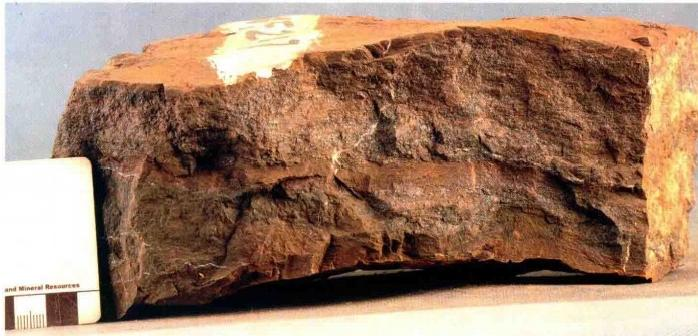
Fine sandstone interbedded with siltstone.
The rock is dark brown in colour, with a fine‑grained to silty texture and a thin‑bedded to banded structure. The rock consists of two lithologies, dominated by fine‑grained quartz sandstone with subordinate argillaceous siltstone.
The fine‑grained quartz sandstone has a sandy texture. Its main mineral is quartz, which is colourless, transparent, anhedral granular, with grain sizes generally around 0.2 mm and some up to 0.5 mm, accounting for 60%–70% of the rock. Biotite is unevenly distributed in the rock, constituting about 15%, in fine flaky grains. In addition, very fine‑grained feldspar minerals may be present.
The argillaceous siltstone occurs as thin beds or bands within the rock, composed mainly of argillaceous material and fine silt. The grains are too fine to be distinguished with the naked eye or even under a magnifying glass.
The rock has a relatively dark colour, especially the argillaceous siltstone, which is reddish‑brown. It effervesces weakly with hydrogen peroxide, indicating the presence of trace pyrolusite; it should therefore be the near‑ore wall rock of the manganese ore body.
Sample Mn1‑B14
Manganese ore.
The ore is black to brownish‑black in colour, with a euhedral to subhedral granular texture and a massive to banded structure. The ore minerals are dominated by manganite, which occurs as euhedral to subhedral prismatic and granular crystals. It is black, with a brown streak, submetallic lustre, relatively low hardness (scratched by a knife), and grain sizes of 1–2 mm, with some prismatic crystals up to 5 mm in length. Vertical striations are well developed on the prism faces. Manganite accounts for more than 50% of the rock.
The gangue minerals consist mainly of fine to very fine‑grained silt and argillaceous material; the grains are too fine to be distinguished with the naked eye, and they total less than 50% of the rock.
The ore effervesces weakly with hydrogen peroxide, indicating the presence of pyrolusite. This effervescence is observed mainly in the argillaceous thin laminae where mud is concentrated, but not in the areas where black manganite is concentrated.
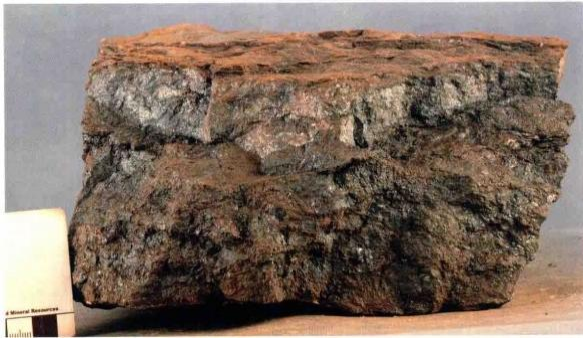
Sample Mn1‑B15
Fine sandstone interbedded with argillaceous siltstone.
The rock is dark brown to reddish‑brown in colour, with a fine‑grained to silty texture and a thin‑bedded to banded structure. The rock consists of two lithologies, dominated by fine‑grained quartz sandstone with subordinate argillaceous siltstone.
The fine‑grained quartz sandstone has a fine sandy texture. Its main mineral is quartz, which is colourless, transparent, with a greasy lustre, anhedral to rounded granular, with grain sizes generally around 0.2 mm and some up to 0.5 mm, accounting for about 80% of the rock. Biotite is unevenly distributed in the rock as fine flaky grains, constituting about 5%. In addition, very fine‑grained feldspar minerals may be present.
The argillaceous siltstone occurs as thin beds or bands within the rock, composed mainly of argillaceous material and fine silt, with very fine grain sizes. The rock has a relatively dark colour, appearing dark brown, and effervesces weakly with hydrogen peroxide, indicating that it may contain pyrolusite. It should therefore be mineralised wall rock or near‑ore wall rock.
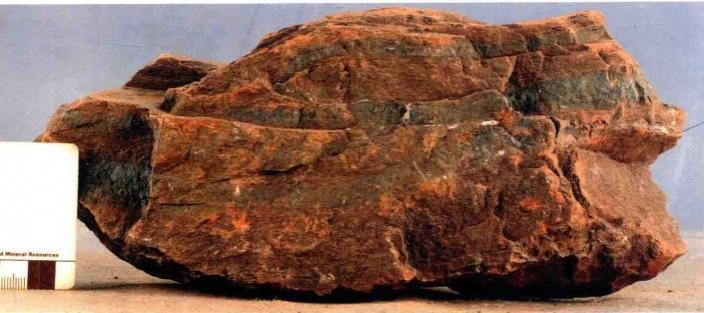
Sample Mn1‑B16
Manganese‑bearing laminated limestone.
The rock is grey to light grey on fresh surfaces, and yellowish‑brown to brownish‑yellow on weathered surfaces. It has a very fine‑grained silt‑sized crystalline (micro‑to‑silt‑crystalline) texture and a finely laminated structure. The main mineral is calcite, with minor pyrolusite.
Calcite is white, very fine‑grained, and effervesces with dilute hydrochloric acid; it accounts for about 90% of the rock.
Pyrolusite is unevenly distributed in the rock as black fine grains and spots, mostly 0.1–0.5 mm in diameter. When hydrogen peroxide is applied, the black pyrolusite grains effervesce vigorously, while the surrounding areas do not, indicating an uneven distribution. In some local concentrations, the pyrolusite content can reach 10%, but the average content is about 3%.
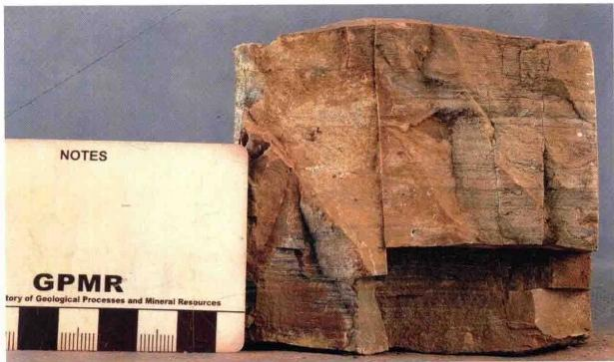
Mn1‑b01
Fine‑grained calcareous dolomite.
Very fine‑grained recrystallized texture, massive structure. The rock is composed mainly of dolomite (Dol), which is anhedral and granular. It exhibits undulose extinction and high‑order white interference colours. Grain sizes vary considerably, showing a mottled (patchy) distribution among different grains, ranging from 0.003 to 0.25 mm, and it accounts for approximately 95% of the rock.
Calcite (Cal) also exhibits undulose extinction and high‑order white interference colours. It is distributed along rock fractures, with grain sizes of 0.01 to 0.02 mm, constituting about 3%–4% of the rock. Minor metallic minerals are also observed.

Mn1‑b02
Micro‑laminated micritic dolomite.
Micritic texture, micro‑laminated structure. The rock is composed mainly of dolomite (Dol), which is anhedral and granular, exhibits undulose extinction and high‑order white interference colours, with grain sizes ranging from 0.003 to 0.05 mm, accounting for approximately 95% of the rock. The metallic minerals are mainly granular ferruginous minerals, partly as iron oxides infilled along rock fractures, in minor amounts.

Mn1‑b03
Manganese‑bearing detrital dolomitic limestone.
Intraclastic texture, massive structure. The rock is composed mainly of intraclasts (Grav), which are subangular to subrounded, with dominant grain sizes of 0.05–0.25 mm, some ranging from 0.5 to 2 mm, and very few exceeding 2 mm; they account for about 80% of the rock. Terrigenous clasts are angular to subangular, consisting mainly of sand‑sized fragments of quartz, feldspar, etc. (Sand), with grain sizes of 0.05–0.2 mm, constituting about 5%. The metallic minerals are mainly fine‑grained, disseminated ferruginous oxides (Fe+Dol), which cement the rock and account for approximately 10% of the total rock.
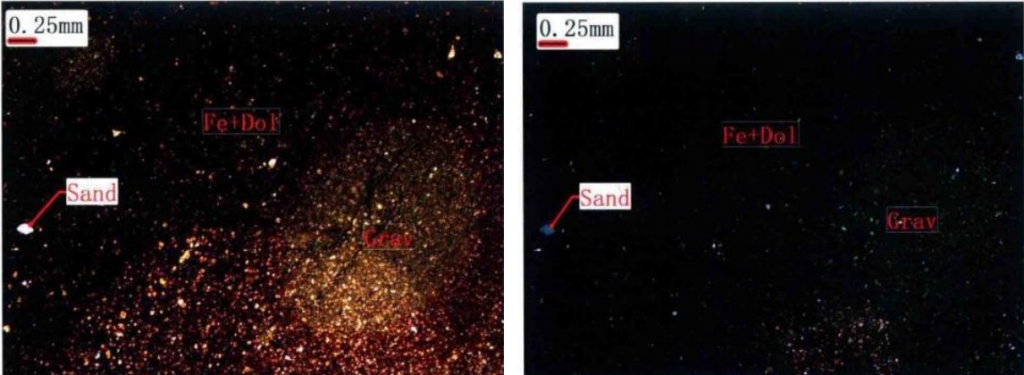
Mn1‑b04
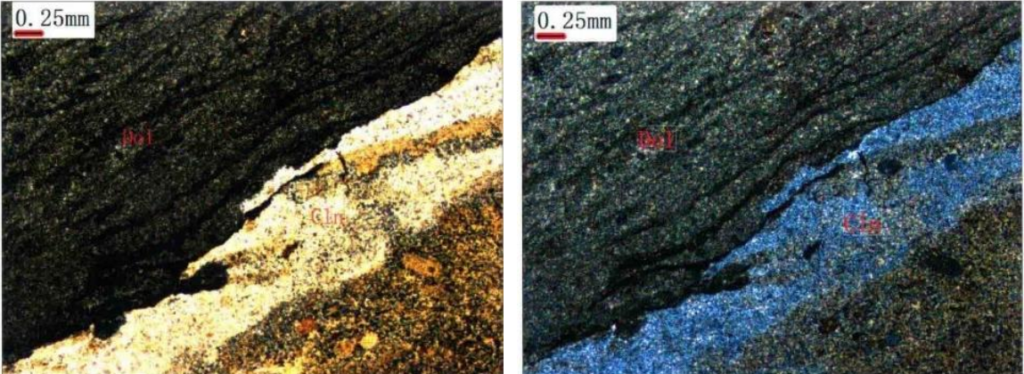
Banded calcareous dolomite with chert.
The rock has a lepidogranoblastic texture and a nodular to banded structure. It is mainly composed of dolomite (Dol), which is anhedral, granular, exhibits undulatory extinction, and shows high‑order white interference colours. Grain size ranges from 0.003 to 0.05 mm, accounting for approximately 85% of the rock. Chalcedony (Ch) is cryptocrystalline siliceous material, occurring predominantly as nodules and bands within the dolomite, with a content of about 15%.
Mn1‑b05
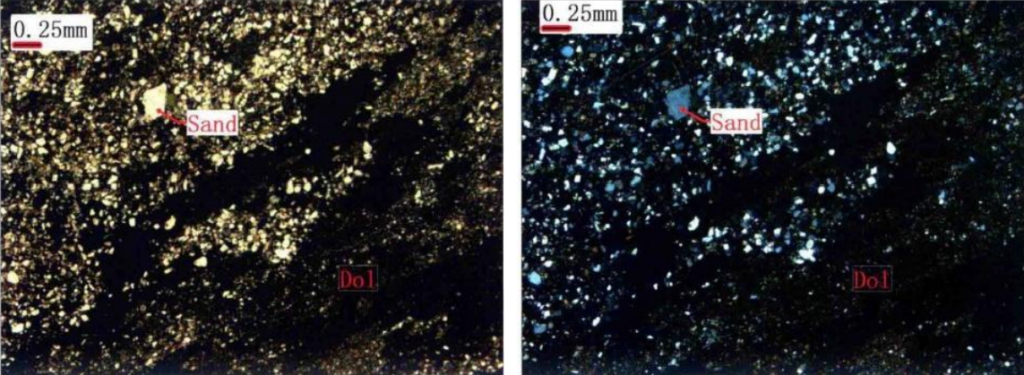
Hematite‑bearing microcrystalline calcareous dolomite.
Sandy micritic texture, massive structure. The rock is composed mainly of micritic dolomite (Dol), with grain sizes <0.004 mm, accounting for approximately 60% of the rock. Sand‑sized clasts (Sand) are angular to subangular, consisting mainly of mineral fragments of quartz, feldspar, mica, etc., with grain sizes of 0.05–0.25 mm and a few grains exceeding 0.25 mm; they constitute about 30% of the rock. Minor ferruginous material is present as disseminated iron oxides and iron hydroxides, accounting for about 5% of the rock.
Mn1‑b06
Ferruginous‑manganiferous argillaceous siltstone.
Micritic sandy texture, layered structure. The rock is composed mainly of sand‑sized clasts (Sand), which are angular to subangular and consist mainly of mineral fragments of quartz, feldspar, mica, etc. They have dominant grain sizes of 0.003–0.05 mm, with a few grains larger than 0.05 mm, and account for about 60% of the rock. Secondly, micritic dolomite (Dol), with grain sizes less than 0.004 mm, acts as cement in the rock and constitutes 30%–35%. Dispersed ferruginous‑manganiferous material is visible, partly in laminated or micro‑laminated forms, with a content of about 10%.

Mn1‑b07
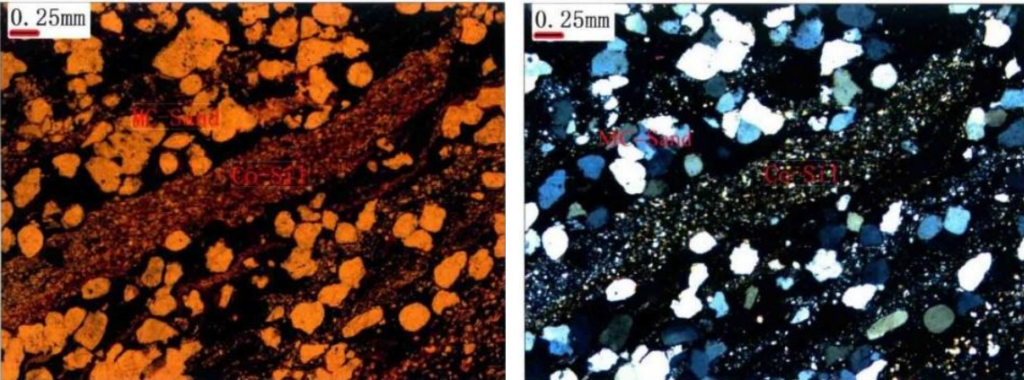
Fine sandstone interbedded with siltstone.
Sandy texture, folded layered structure. The main rock component is medium‑fine grained sandstone (MC‑Sand), intercalated with silty layers (Co‑Sil) and chert layers.
Mn1‑g01
Massive dense manganese ore.
Cryptocrystalline to microcrystalline texture, with colloidal structures such as oolitic and concentric ring forms. The metallic minerals are mainly psilomelane (Ps), pyrolusite (Pyt), and hematite (Hem), with cryptocrystalline to microcrystalline textures and colloidal structures such as oolitic and concentric ring forms, totalling about 35% of the rock.


Mn1‑g02
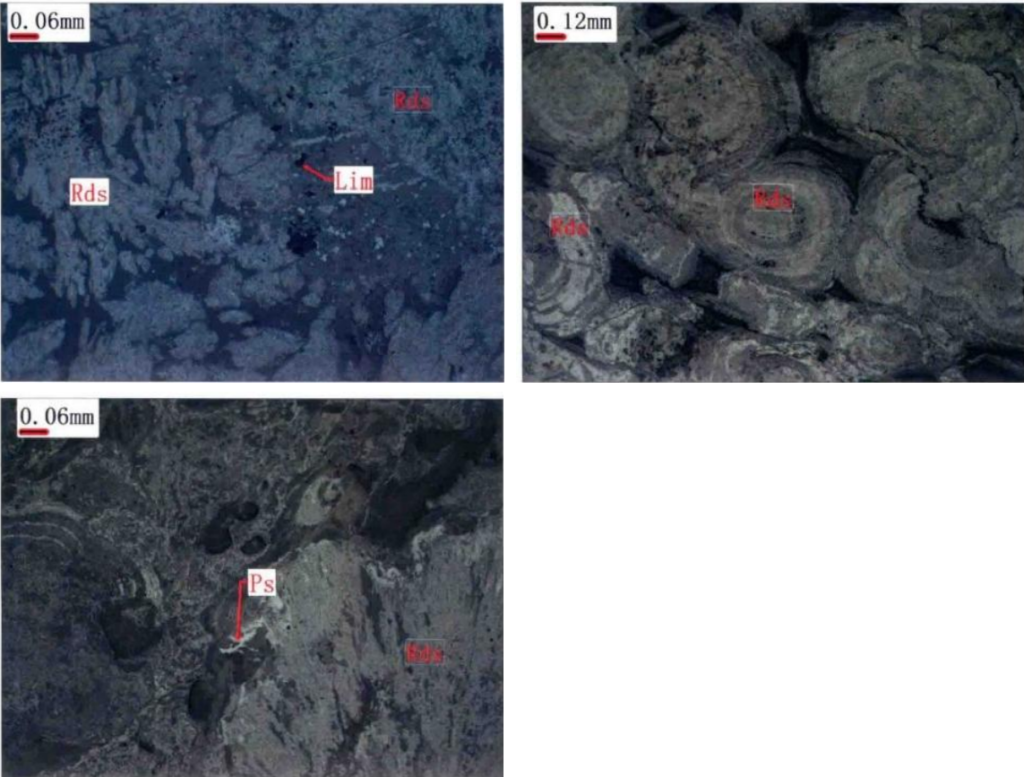
Massive dense manganese ore.
Cryptocrystalline to microcrystalline texture, with colloidal structures such as oolitic and concentric ring forms. The metallic minerals are mainly rhodochrosite (Rds), psilomelane (Ps), and limonite (Lim), etc., totalling about 30% of the rock.
 English English
 Spanish
 Russian
 Arabic
 Swahili
 French
 Turkish
 Portuguese
 Korean
 Japanese
 German
 Italian