
Rotary Dryer
1. Product Overview Rotary dryers are widely used in building materials, metallurgy,…

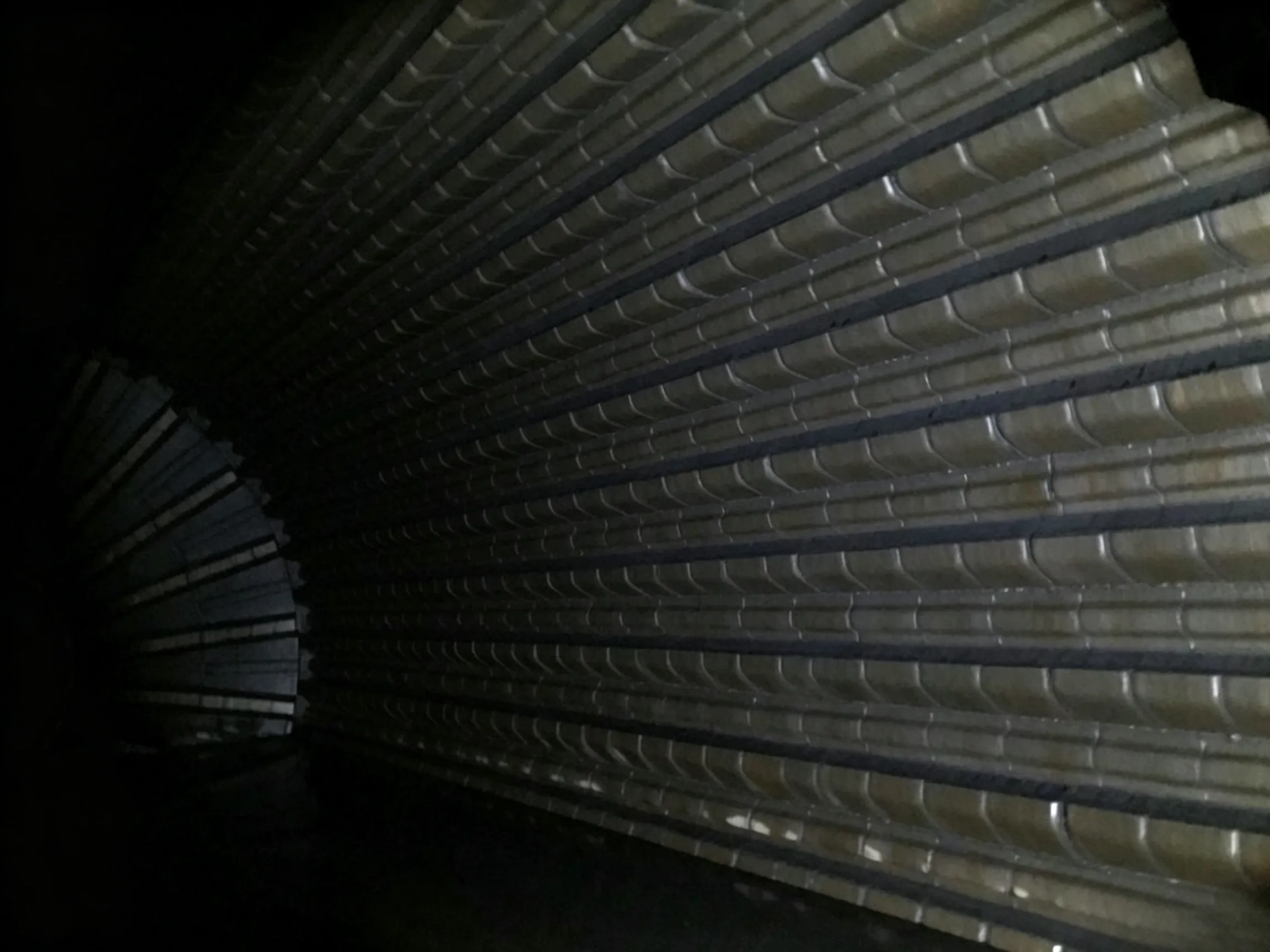
Typically, the wear of rubber liners is mainly concentrated at one or both ends of the mill shell. In order to achieve a consistent service life across the entire shell lining and reduce downtime for liner replacement, steel blocks are added to the heads of the lifter bars, resulting in the (alloy steel) metal-headed rubber liner. Table 5‑9 lists several common configurations of alloy‑rubber composite liners. Over the past 20 years, increasing attention has been paid to metal-headed rubber liners (as shown in Figure 5‑20), and their application has become more widespread. Another configuration is the alloy‑insert rubber composite base liner, as shown in Figure 5‑21.
Table 5-9 Combinations of alloy-rubber composite lining plates
| serial number | “Upgrade bar” | baseplate | Image or photo | |
| 1 | metal | rubber | ||
| 2 | Metal head – rubber | rubber | Figure 5-20 | |
| 3 | Metal head with rubber | Rubber filled with metal | Figure 5-21 | |
| 4 | Some parts are lined with metal, while others are lined with rubber | |||

The basic concept of the metal-headed liner is that the wearing surface is made of alloy metal, which is supported by the rubber material underneath (as shown in Figure 5‑20). The metal head provides high wear resistance, while the underlying rubber cushions impact forces. Fixing the metal head onto the elastic, wear‑resistant rubber allows free selection of the metal material. The material of the metal head can be the same as that used for all‑metal liners, but harder grades may also be used.
Another important detail is the connection between the metal and the rubber. This is because it must have sufficient bond strength to withstand the rotational loads inside the mill. The connection between metal and rubber is achieved through a dual mechanism of chemical adhesive combined with mechanical attachment, ensuring that the two materials remain firmly bonded throughout the service life without separating. The bonding or adhesion between metal and rubber has a great influence on the reliability of the liner. As shown in Figure 5‑22, the detachment of a metal head at the feed end of an 8‑m diameter SAG mill resulted in an additional 40 hours of downtime for replacement.

The advantages of all metal-headed liners depend on the design of the metal head. Since the base plate is still rubber, it provides leak‑proof sealing and may sometimes require no retensioning. The rubber base is light and can be handled and replaced manually. The metal‑headed rubber lifter bars are compatible with the same manipulators used for replacing all‑metal liners; alternatively, they can be lifted with a simple air lift, which can make liner installation even faster. For example, replacing the entire set of metal‑headed rubber liners in a 6 m × 2.5 m AG mill—including removal of the existing rubber liners and replacement of the feed‑end liners, shell liners, and grate plates—took only 108 hours.
Metal‑rubber composite liners have superior impact resistance. As shown in Figure 5‑23, in the same mill, the metal liner was damaged while the metal‑rubber liner showed no damage. In 2002, a trial set of metal‑rubber composite liners was installed in a 36 ft (11 m) SAG mill at Los Pelambres in Chile; no premature cracking was observed, whereas the conventional cast chrome‑molybdenum alloy shell liners previously used often suffered extreme impact damage to the base plates, leading to unscheduled downtime for shell liner replacement. Another example is the 38 ft (11.6 m) SAG mill at Escondida.
During the development of metal‑headed rubber liners, various shapes and alloy grades of metal head blocks have been developed. Current designs allow the liner to be used until the metal head is completely worn away. When the metal‑headed rubber lifter bars have to be replaced, most of the metal has already been worn down, leaving only the rubber portion of the lifter bar. As a result, the weight of the lifter bars is greatly reduced, making removal very easy, and the remaining metal scrap is of little value. At the same time, the risk of injury to personnel during liner replacement is greatly reduced.
The base of the metal‑headed rubber liner is the same as that of conventional rubber lifter bars, equipped with a T‑bolt fastening and tensioning system. The Trellex type (shown in the first four images of Figure 5‑20) is easy to secure and convenient for size selection.

Figure 5-23 Metal lining plate and metal-
Comparison of rubber composite lining boards
(The damage is to the metal lining plate)


 English English
 Spanish
 Russian
 Arabic
 Swahili
 French
 Turkish
 Portuguese
 Korean
 Japanese
 German
 Italian