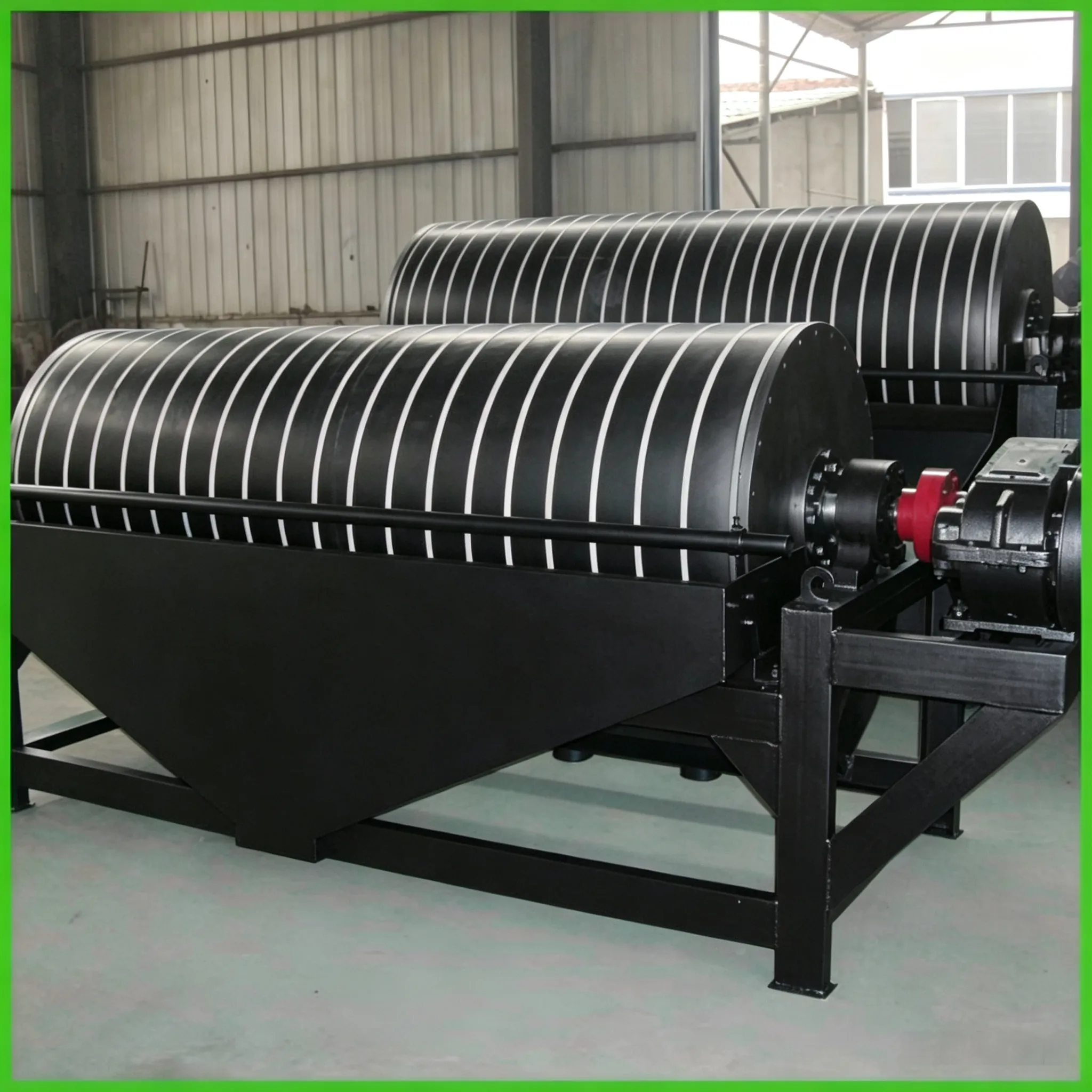
Construction of Permanent Magnetic Drum Separators
Permanent magnetic drum separators are widely used for magnetite ore beneficiation, coarse…

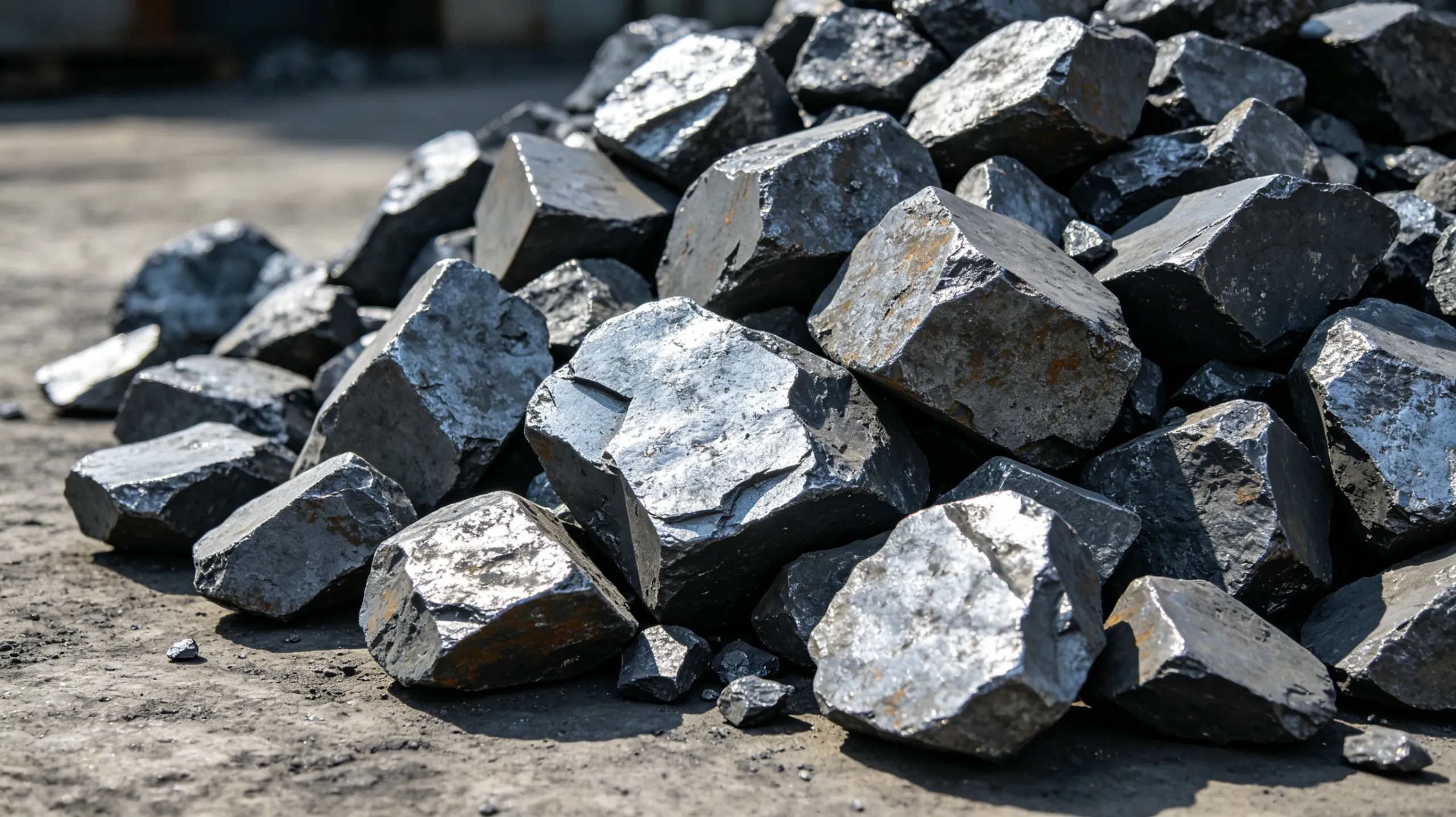
1.1 Geographical Location
The Dagushan Ore Processing Plant is located 9 km southeast of Anshan City, Liaoning Province, at the foot of Qianshan Mountain. The plant is connected to the city center and Ansteel plant by railway and highway. It mainly produces iron concentrate and is a major raw material base for Ansteel.
1.2 Development History
The Dagushan Ore Processing Plant was originally the ore processing workshop of the Dagushan Iron Mine. Construction began in 1954, and it went into operation in October 1955. In 1978, the fine screening and regrinding process was upgraded. On December 11, 1983, the Dagushan Iron Mine was divided into a plant and a mine, and the Dagushan Ore Processing Plant officially began independent operation. Currently, the plant consists of eight workshop-level units: a branch plant, crushing workshop, magnetic separation workshop, three-stage separation workshop, filtration workshop, tailings workshop, power workshop, and maintenance coordination center, as well as departments such as the Production Technology Department, Equipment Department, and Comprehensive Management Department. The plant covers a total area of 3,425,600 m², with a building area of 133,200 m². The total weight of the equipment is 21,900 tons, including 11 crushers, 33 ball mills, and 14 filters.
1.3 Water Source: Fresh water and circulating water are supplied to the main water pumping station of the ore dressing plant from Ansteel’s Water Supply Plant No. 15 and No. 5 pumping stations, respectively, with flow rates of 250 m³/h and 450 m³/h. Zero discharge of wastewater is achieved.
1.4 Power Supply: The power supply system is provided by Ansteel via two 4.44kV high-voltage transmission lines to the plant’s No. 8 main step-down substation, and then distributed to the substations of each workshop in the ore dressing plant.
Currently, the ore processed by the ore dressing plant is supplied by Dagushan Mine and Qianyanshan Mine, accounting for 67% and 33% respectively. The ore processed by the branch plant is supplied by Dagushan Mine and its affiliated enterprises, including those of Qianyanshan Mine.
In 1978, the magnetic separation workshop adopted a fine screening and regrinding process, increasing the annual raw ore processing capacity to over 4 million tons. In 1988, the ball mills in systems 7-10 were modified to 62700mm × 3600mm. The tertiary separation workshop eliminated flotation in early 1975, replacing it with a magnetic separation process, and added a fine screening and regrinding process in 1979. In 1981, the three Ø1650mm short-head cone crushers in the secondary fine crushing workshop were replaced with one 62100mm and two 92200mm short-head cone crushers, and a screening unit was added to form a closed-circuit crushing system. In 1989, the Ø2100mm short-head cone crusher was replaced with a 62200mm short-head cone crusher. In the 2001 “66” technical upgrade of the tertiary ore beneficiation system, the screening machine was further upgraded from the original 1500mm×3000mm self-centering vibrating screen to a 2YA1530 circular vibrating screen. This reduced the particle size of the raw ore supplied to the tertiary ore beneficiation workshop from 85% -12mm to over 90% -12mm, thus increasing the annual raw ore processing capacity of the tertiary ore beneficiation workshop to over 2 million tons. From 1987 to 1990, a “demolition of five and construction of four” technological upgrade was implemented, increasing the annual raw ore processing capacity from 5.4 million tons in 1987 to 6 million tons in 1990; iron concentrate production increased from 1.9 million tons in 1987 to 2.26 million tons in 1990. In 1995 and 1997, automatic control was implemented in the ball mills of the magnetic separation systems 7-10 and 2-6, respectively, increasing the hourly processing capacity to 49.5 tons. In 2002, automatic control of the ball mills was implemented in all three separation processes. In 1996, a tailings reprocessing process was newly built, producing 20,000 tons of iron concentrate with a grade of 63.3% annually. In 2000, the tailings reprocessing was further upgraded, adopting a new high-efficiency recovery machine to reduce the final tailings grade to below 9%.
To improve quality and efficiency, the three-stage beneficiation process was partially modified in 1985, increasing the iron concentrate grade from 62.5% to 63%. In 1987, a new type of high-efficiency high-frequency vibrating fine screen was independently developed to replace hydrocyclones, improving classification efficiency and the grade of magnetically separated iron concentrate. This technology was granted a national patent in 1988. Starting in 2000, the Dagushan beneficiation plant accelerated its technological transformation, implementing one project per month and achieving significant progress annually, creating a “major upgrade model.” In 2000, the “65” upgrade project for the three-stage beneficiation process was implemented, increasing the iron concentrate grade from 64% to 65%. In 2001, the “66” upgrade was implemented, adopting a two-stage continuous grinding-single magnetic separation-fine screening and regrinding process, increasing the iron concentrate grade from 65% to 66%, bringing considerable economic benefits to the Dagushan beneficiation plant and the mining company.
Since the Ninth Five-Year Plan, with the deepening of reform and opening up and the development of the market economy, in order to build a modern new Anshan Mining Group, the company has established the business strategy of expanding the iron ore mine and developing the ore dressing plant, and set the third development goal of building a high-quality raw material base and creating a world-class mining enterprise. Accelerating the transformation of the ore dressing plant and the construction of new mines will enable Anshan Mining to become the first mining enterprise in China to process 10 million tons of ore annually. To achieve this goal, the company has carried out a complete overhaul of its original production processes. In 2004, the ore dressing plant underwent iron ore extraction and silicon reduction upgrades, and significant changes were made to the crushing and magnetic separation processes, resulting in a raw ore processing capacity of 9 million tons of crushing, 7 million tons of magnetic separation, and 2 million tons of three-stage beneficiation. In addition to retaining the original primary crusher, the crushing workshop includes a newly constructed secondary and fine crushing plant, a screening plant, 14 conveyor belt corridors, and 10 transfer stations. It will be equipped with six Swedish-imported H8800 crushers, eleven 2YA2460 circular vibrating screens, and corresponding conveyor belts, lifting equipment, etc. This project will transform the original crushing process from three stages of crushing, three stages of screening, and one closed-circuit operation (a total of six steps) to a three-stage closed-circuit operation with pre-screening before secondary crushing. The original crushing capacity will increase from 6.6 million tons per year to 9 million tons per year. The feed particle size will be 1000–0 mm, and the product particle size will increase from -12 mm (70%) to -12 mm (95%).
The magnetic separation workshop upgraded its original 10 Ø2700mm×2100mm and 4 φ2700mm×3600mm grid-type ball mills in the primary stage to 6 63600mm×6000mm overflow-type ball mills. The secondary stage upgraded its 10 Ø2700mm×2100mm and 4 92700mm×3600mm overflow-type ball mills to 4 63600mm×6000mm overflow-type ball mills. The grading equipment was uniformly upgraded to φ500mm×8 dynamic pressure feed hydrocyclone units. The process adopted was staged grinding-single magnetic separation-fine screening and regrinding. The planned total investment for the project was 196 million yuan. Construction began on January 3, 2004, the new No. 6 secondary separation system officially went into operation on August 31, and the entire project was completed on December 20. The actual total investment for the project was 170.2601 million yuan.
This project achieved the remarkable feat of simultaneously upgrading and producing, without reducing output, and even increasing it. After commissioning, the iron concentrate output of the magnetic separation workshop increased from 1.8 million tons per year to 2.53 million tons per year, and the concentrate quality improved from 66.6% to 67.2%. This technological upgrade achieved improvements in mineral product quality and the large-scale, automated use of equipment, placing the large-scale processing plant among the world’s top-tier concentrators.
In October 2006, a new tailings reprocessing unit and a new tailings pumping station were put into operation. The tailings reprocessing unit adopted a new type of recovery machine, improving recovery efficiency. The two tailings pumping stations were merged into one.
From December 2006 to March 2007, the filtration system was upgraded, with the construction of seven new 60m² ceramic filters; the removal of eight 25m² internal vacuum filters in the third-stage separation unit, and the installation of four 72m² disc vacuum filters.
Currently, iron concentrate is supplied to Ansteel’s Ironmaking Plant and Ansteel Mining Company’s Pelletizing Plant. Tailings from each beneficiation stage are concentrated in high-efficiency thickeners. The overflow is purified by a newly built water treatment system and reused as circulating water. The underflow is recovered by a re-selection system and then pumped to the tailings pumping station, where it is transported to the tailings dam. Tailings are discharged through a multi-pipe system and dammed with rock. Currently, the discharge point is the external expansion dam. After beneficiation at the beneficiation plant, the concentrate is pumped in series to the pre-filtration thickening operation. Tailings are thickened by a separate 653m³ thickener, with the overflow reused as circulating water. The tailings are then directly pumped to the tailings dam by an underflow pump.
3.1 Ore Types and Distribution The Dagushan iron ore mine is divided into two main parts: the Bindong mining area and the Binxi mining area. The natural types of ore include magnetite quartzite, amphibole (chlorite) magnetite quartzite, pseudomorphic hematite quartzite, and pseudomorphic hematite magnetite quartzite. The Bindong mining area contains unoxidized ore, consisting of magnetite quartzite and amphibole (chlorite) magnetite quartzite; the Binxi mining area contains partially oxidized and semi-oxidized ore, mainly magnetite quartzite. In the production practice of the Dagushan ore beneficiation plant, the iron silicate content has a significant impact on production and is one of the important indicators for evaluating the quality of Dagushan iron ore. Therefore, when classifying Dagushan iron ore, the Dagushan ore beneficiation plant refers to ore with an iron silicate content ≥3% as amphibole-type iron ore and ore with an iron silicate content <3% as quartz-type iron ore. Amphibole-type iron ore mainly includes two types: one is chlorite-amphibole magnetite quartzite; the other is chlorite-amphibole magnetite quartzite. Quartz-type iron ore mainly includes four types: chlorite-bearing magnetite quartzite, magnetite quartzite, pseudomorphic hematite quartzite, and semi-pseudomorphic hematite quartzite. Two important characteristics of the Dagushan iron mine should be noted: first, the iron silicate content in the Binxi mining area is relatively low, and the iron ore is mostly quartz-type; second, with the increase of mining depth, the decrease in oxidized ore is significant, but the increase in semi-oxidized ore is more significant, and the decrease in oxidized ore can be basically compensated by the increase in semi-oxidized ore.
3.2 Chemical Composition and Phase Analysis of Ore
3.2.1 Chemical Composition of Ore
Based on the content of various types of minerals, seven representative ore samples and one comprehensive ore sample were taken from both the Bindong and Binxi mining areas for complete chemical analysis. The results are shown in Tables 1 and 2, respectively.
Table 1. Results of complete chemical analysis of various ores from Bindong. (%)
| sample | TFe | SiO₂ | TiO₂ | Al₂O₃ | Fe₂O₃ | FeO | MgO | CaO | K₂O | Na₂O | MnO | P₂O₅ | Burning | S |
| 1 | 29.69 | 50.56 | 0.01 | 0.99 | 21.51 | 18.86 | 3.28 | 0.91 | 0.010 | 0.470 | 0.17 | 0.108 | 1.57 | 0.139 |
| 2 | 32.06 | 47.12 | 0.02 | 1.08 | 26.77 | 17.18 | 2.28 | 1.24 | 0.057 | 0.037 | 0.16 | 0.059 | 2.29 | 0.100 |
| 3 | 33.94 | 43.46 | 0.01 | 1.01 | 29.32 | 17.30 | 2.76 | 1.24 | 0.010 | 0.040 | 0.14 | 0.104 | 1.80 | 0.195 |
| 4 | 41.28 | 34.92 | 0.02 | 0.45 | 37.82 | 19.10 | 1.33 | 1.74 | 0.012 | 0.047 | 0.13 | 0.079 | 1.78 | 0.140 |
| 5 | 34.37 | 43.80 | 0.02 | 2.08 | 30.50 | 16.79 | 0.97 | 2.40 | 0.010 | 0.032 | 0.12 | 0.100 | 1.75 | 0.128 |
| 6 | 35.55 | 41.92 | 0.02 | 0.61 | 28.96 | 19.70 | 2.40 | 0.91 | 0.010 | 0.060 | 0.22 | 0.092 | 2.94 | 0.145 |
| 7 | 31.21 | 37.19 | 0.01 | 2.02 | 25.38 | 17.33 | 4.90 | 4.88 | 0.025 | 0.038 | 0.23 | 1.74 | 5.43 | – |
| average | 34.48 | 43.63 | 0.02 | 1.04 | 29.14 | 18.39 | 2.17 | 1.41 | 0.018 | 0.114 | 0.16 | 0.88 | 2.02 | 0.141 |
Table 2. Results of complete chemical analysis of various ores from Binxi. (%)
| Sample | TFe | SiO₂ | TiO₂ | Al₂O₃ | FeO₃ | FeO | MgO | CaO | K₂O | Na₂O | MnO | P₂O₅ | burning | S |
| 1 | 33.40 | 42.06 | 0.100 | 1.08 | 26.85 | 18.83 | 2.94 | 1.49 | 0.035 | 0.048 | 0.250 | 0.089 | 3.78 | 0.334 |
| 2 | 29.15 | 51.04 | 0.017 | 0.42 | 28.84 | 11.55 | 0.75 | 2.92 | 0.034 | 0.260 | 0.146 | 0.095 | 2.82 | 0.456 |
| 3 | 33.45 | 45.52 | 0.014 | 0.55 | 32.39 | 13.90 | 1.40 | 2.62 | 0.034 | 0.100 | 0.146 | 0.085 | 3.22 | 0.084 |
| 4 | 33.64 | 44.58 | 0.010 | 0.99 | 26.73 | 19.25 | 3.21 | 1.14 | 0 | 0.025 | 0.170 | 0.244 | 1.82 | – |
| 5 | 31.18 | 49.42 | 0.012 | 0.42 | 33.03 | 10.40 | 0.70 | 2.58 | 0 | 0.260 | 0.115 | 0.091 | 2.38 | 0.150 |
| 6 | 25.40 | 56.30 | 0.019 | 0.48 | 25.60 | 9.65 | 0.80 | 2.38 | 0 | 0.060 | 0.113 | 0.086 | 2.59 | 0.689 |
| 7 | 29.90 | 50.08 | 0.016 | 0.45 | 29.47 | 11.95 | 0.70 | 2.78 | 0 | 0.060 | 0.136 | 0.090 | 3.24 | 0.350 |
| average | 30.81 | 48.43 | 0.027 | 0.63 | 28.98 | 13.65 | 1.50 | 2.27 | 0.015 | 0.116 | 0.153 | 0.111 | 2.83 | 0.344 |
As shown in Tables 1 and 2, all ores are high-silicon, low-iron, and low-sulfur phosphate-iron ores. However, it is noteworthy that the average sulfur content in the Binxi mining area is 0.344%, close to the allowable value of 0.5% for iron ore, with some areas reaching as high as 0.689%. Meanwhile, the FeO content in the Bindong mine ranges from 16.79% to 19.70%, with an average of 18.39%, which is high and relatively stable, indicating that the Bindong mine is a primary ore. In contrast, the FeO content in the Binxi mine ranges from 9.65% to 19.25%, with an average of 13.65%, which is low and fluctuates significantly, indicating that the Binxi mine has undergone oxidation.
3.2.2 Phase Analysis of Ore
Based on the occurrence state of iron minerals in the Bindong and Binxi mining areas, phase analysis was conducted on 6 representative ore samples and one composite ore sample from the Bindong mining area, and 9 representative ore samples and one composite ore sample from the Binxi mining area. The results are shown in Tables 3 and 4, respectively.
Table 3. Phase analysis results of various ores from Bindong (%)
| sample | TFe | Fe₃O₄ | FeSiO₃ | FeCO₃ | Fake and semi-fake hematite | Hematite and limonite | Magnetic iron occupancy |
| 1 | 31.97 | 24.60 | 6.20 | 0.60 | 0.50 | 0.07 | 76.95 |
| 2 | 35.32 | 30.00 | 3.40 | 1.80 | – | 0.12 | 84.94 |
| 3 | 36.30 | 31.20 | 3.80 | 0.80 | 0.40 | 0.10 | 85.95 |
| 4 | 36.86 | 32.40 | 2.80 | 0.45 | 0.30 | 0.91 | 87.98 |
| 5 | 37.41 | 30.60 | 2.70 | 3.70 | 0.20 | 0.21 | 81.80 |
| 6 | 30.16 | 24.90 | 2.40 | 2.00 | 0.60 | 0.26 | 82.56 |
| Average | 35.15 | 29.76 | 3.22 | 1.56 | 0.33 | 0.28 | 84.67 |
Table 4. Phase analysis results of various ores from Binxi. (%)
| Sample | TFe | Fe₃O₄ | FeSiO₃ | FeCO₃ | Fake and semi-fake hematite | Hematite and limonite | Magnetic iron occupancy |
| 1 | 32.54 | 25.23 | 6.03 | 0.64 | 0.60 | 0.04 | 77.54 |
| 2 | 28.76 | 23.70 | 1.00 | 1.80 | 1.10 | 1.16 | 82.41 |
| 3 | 33.09 | 28.50 | 1.10 | 1.30 | 1.25 | 0.94 | 86.13 |
| 4 | 34.90 | 28.50 | 3.60 | 2.60 | 0.20 | – | 81.66 |
| 5 | 30.29 | 25.50 | 1.10 | 1.75 | 1.10 | 1.04 | 84.19 |
| 6 | 30.71 | 20.70 | 0.70 | 1.70 | 4.30 | 3.31 | 67.40 |
| 7 | 31.13 | 21.60 | 0.80 | 1.40 | 2.70 | 4.63 | 69.39 |
| 8 | 24.99 | 19.20 | 0.80 | 2.50 | 2.10 | 0.39 | 76.83 |
| 9 | 29.60 | 23.40 | 0.90 | 1.80 | 1.20 | 2.30 | 79.05 |
| Average | 30.16 | 24.04 | 1.25 | 1.72 | 1.62 | 1.53 | 79.71 |
As shown in Tables 3 and 4, the content of magnetic iron in the Bindong mine ranges from 76.95% to 87.98%, with an average of 84.67%; while in the Binxi mine, the content ranges from 67.40% to 86.13%, with an average of 79.71%. Clearly, the content of magnetic iron in the Bindong mine is about 5% higher than that in the Binxi mine. The FeSiO₃ content in the Bindong mine ranges from 2.40% to 6.20%, with an average of 3.22%; while in the Binxi mine, the FeSiO₃ content ranges from 0.70% to 6.03%, with an average of 1.25%. Clearly, the FeSiO₃ content in the Bindong mine is significantly higher than that in the Binxi mine. The iron content in the pseudomorphs, semi-pseudomorphs, and hematite of the Bindong mine ranges from 0.12% to 1.21%, with an average of 0.61%; the iron content in the pseudomorphs, semi-pseudomorphs, and hematite of the Binxi mine ranges from 0.20% to 7.61%, with an average of 3.15%. This indicates that the Binxi mine has undergone oxidation.
3.3 Mineral Composition and Occurrence State of Major Minerals in the Ore The main useful iron mineral in the Dagushan iron ore is magnetite, followed by pseudomorphic hematite; the gangue is mainly quartz, followed by actinolite, amphibole, magnesia-iron amphibole, hornblende, chlorite, chlorophyllite, pyrochlore, calcite, iron-bearing calcite, and siderite.
The magnetite in the Dagushaniron ore is mostly anhedral to subhedral, with some euhedral magnetite occurring mainly as inclusions. Magnetite often forms the main component of iron bands in agglomerated banded form, interspersed with a small amount of irregular gangue minerals. Most magnetite is of high purity and contains few impurities; magnetite containing impurities mainly contains some silicate minerals. Overall, the grain size of magnetite varies greatly, even between very similar groups of magnetite. Pseudohematite mainly appears in the Binxi mining area, mostly in a coupled or mixed state with magnetite, appearing as a replacement on the outer edge of magnetite or along its internal crystal faces. The distribution of pseudohematite in the Binxi mining area is also uneven; oxidation is barely visible in the eastern part of the Binxi mining area; the content of pseudohematite is generally higher in the central part of the Binxi mining area, and in some areas, iron minerals are even dominated by pseudohematite; the content of pseudohematite is lower in the western part of the Binxi mining area, but its distribution is more widespread. Quartz in the Dagushan iron ore is mostly anhedral, generally medium to fine-grained. Quartz grains vary in size. Coarser quartz has a purer surface, formed by recrystallization; finer quartz has a lower surface purity and often contains iron mineral inclusions and gas-liquid inclusions.
3.4 Ore Structure and Texture
3.4.1 Ore Structure
The ore structure is mainly granular metamorphic, accompanied by replacement texture, inclusion metamorphic texture, and crushing texture. Granular metamorphic texture is widely distributed in all areas of the Dagushan iron mine and can be divided into coarse-grained metamorphic texture, fine-grained metamorphic texture, and inequigranular metamorphic texture. In coarse-grained metamorphic texture, magnetite in iron mineral bands is mostly formed by tightly interlocking subhedral or anhedral grains to form agglomerates; in fine-grained metamorphic texture, magnetite is mostly formed by tightly interlocking subhedral grains with quartz to form a granitic metamorphic texture; in inequigranular metamorphic texture, magnetite mostly exhibits uneven distribution of coarse and fine grains within the same band. The metasomatic structures mostly exhibit incomplete metasomatism of magnetite by pseudomorphic hematite, with some forming metasomatic pseudomorphic structures due to overall metasomatism. The iron minerals in the metamorphic structures are very fine-grained, mostly encased in heteromorphic quartz, and partially encased in chlorite and amphibole minerals. Crushing structures are mainly formed when iron ore is crushed into breccia by tectonic stress, or when mylonitization occurs, causing iron minerals to be broken into fine powder. In these structures, iron minerals are often cemented by carbonate minerals.
3.4.2 Ore Structure
The ore structure is mainly banded and cryptobanded, accompanied by rubbing, brecciated, and massive structures. Generally, banded and cryptobanded structures tend to decrease with depth, while rubbing and brecciated structures tend to increase. This trend is more pronounced in the Binxi mining area than in the Bindong mining area. In the banded and cryptobanded iron ore of the Dagushan iron deposit, the average widths of iron minerals and gangue minerals are similar. In typical banded iron mineral bands, the iron mineral content is as high as 70%–90%, with iron minerals either intercalated as aggregates, partially intercalated, or occurring as single grains in association with quartz. Gangue bands are mainly composed of quartz, while amphibole-type ores contain more amphibole and chlorite, and carbonate ores exhibit disseminated or vein-like distributions of carbonate minerals. Wrinkled and brecciated ores are commonly found near fault lines in the mining area. Wrinkled ores are characterized by regular curvature of iron mineral and gangue mineral bands; brecciated ores show signs of ore fragmentation. In massive ores, the iron and gangue mineral grains are relatively fine, with fewer iron mineral agglomerates but a high degree of euhedrality.
3.5 Ore grain size distribution Four representative ore samples from the Bindong mining area and three representative ore samples from the Binxi mining area were taken for iron mineral grain size distribution determination. The results are shown in Table 5.
As shown in Table 5, the average grain size of iron minerals in the Binxi mining area is 38.54 μm, with 36.59 μm for sample 2 in the west, 41.04 μm for sample 3” in the east, and 52.93 μm for sample 1* in the south. Clearly, the iron minerals in the eastern part of the Binxi mining area are coarser than those in the western part, showing a trend of decreasing size from south to north. The average grain size of iron minerals in the Bindong mining area is 40.06 μm, and the variation in average grain size among different areas is not as pronounced as in the Binxi mining area. The average grain size of gangue in the Binxi mining area is 56.24 μm, while that in the Bindong mining area is 51.68 μm. This indicates that the iron mineral distribution grain size in the Binxi mining area is finer than that in the Bindong mining area, but the gangue distribution grain size in the Binxi mining area is coarser than that in the Bindong mining area.
Table 5. Grain size distribution of Dagushan iron ore. (%)
| sample | item | 2000~ 1168 | 1168~ 833 | 833~ 589 | 589~ 417 | 417~ 295 | 295~ 208 | 208~ 147 | 147~ 104 | 107~ 74 | 74~ 43 | 43~ 35 | 35~ 15 | 15~ 10 | 10~ 0 | 平 均 /μm | |
| Binxi Mining Area | 1 | iron minerals | 0 | 0 | 0 | 0 | 0.42 | 0.89 | 2.72 | 4.89 | 14.07 | 27.06 | 10.91 | 30.92 | 7.74 | 0.37 | 34.61 |
| vein stones | 1.41 | 2.23 | 2.22 | 5.16 | 6.50 | 15.09 | 13.77 | 10.57 | 15.04 | 11.32 | 5.08 | 6.59 | 4.74 | 0.27 | 86.47 | ||
| 2 | iron minerals | 0 | 0 | 0.24 | 0.34 | 1.57 | 3.15 | 5.72 | 9.32 | 11.46 | 20.78 | 10.23 | 28.95 | 7.85 | 0.39 | 36.59 | |
| vein stones | 1.77 | 2.68 | 5.56 | 9.22 | 8.55 | 7.36 | 7.93 | 7.74 | 8.29 | 11.99 | 5.91 | 17.29 | 4.97 | 0.24 | 56.24 | ||
| 3 | iron minerals | 0.25 | 0.47 | 0.78 | 0.78 | 1.89 | 3.80 | 6.36 | 13.90 | 13.86 | 17.45 | 9.49 | 23.75 | 6.85 | 0.35 | 41.04 | |
| vein stones | 1.18 | 2.08 | 3.18 | 5.46 | 6.09 | 9.80 | 9.14 | 9.42 | 8.77 | 13.29 | 6.68 | 19.67 | 4.86 | 0.26 | 51.68 | ||
| average | iron minerals | 0.18 | 0.34 | 0.55 | 0.56 | 1.16 | 3.75 | 6.16 | 10.85 | 12.87 | 18.41 | 10.20 | 26.64 | 7.52 | 0.36 | 38.54 | |
| vein stones | 1.51 | 2.40 | 5.07 | 5.88 | 7.41 | 8.97 | 8.42 | 8.82 | 8.40 | 12.79 | 6.36 | 18.66 | 5.06 | 0.25 | 53.52 | ||
| Bindong Mining Area | 1 | iron minerals | 0.08 | 0.82 | 1.30 | 2.70 | 4.49 | 6.75 | 9.61 | 11.77 | 13.94 | 18.11 | 6.90 | 16.35 | 3.89 | 3.36 | 40.22 |
| vein stones | 1.21 | 1.53 | 2.86 | 5.55 | 7.44 | 9.75 | 11.78 | 12.65 | 13.79 | 15.20 | 5.26 | 10.46 | 1.64 | 0.94 | 67.82 | ||
| 2 | iron minerals | 0.16 | 0.20 | 0.28 | 1.45 | 3.56 | 5.46 | 10.16 | 12.31 | 15.39 | 19.83 | 7.61 | 16.56 | 3.66 | 3.46 | 39.64 | |
| vein stones | 0.92 | 1.26 | 2.43 | 4.87 | 6.97 | 10.71 | 12.66 | 13.05 | 13.92 | 15.26 | 5.35 | 10.06 | 1.56 | 1.06 | 67.70 | ||
| 3 | iron minerals | 0.01 | 0.24 | 0.70 | 1.24 | 4.91 | 8.71 | 12.14 | 12.87 | 15.02 | 17.64 | 6.43 | 13.59 | 3.07 | 3.51 | 39.60 | |
| vein stones | 0.32 | 1.01 | 3.58 | 4.15 | 6.02 | 9.25 | 11.11 | 11.84 | 14.15 | 15.98 | 5.90 | 13.10 | 2.31 | 1.34 | 56.86 | ||
| 4 | iron minerals | 0.01 | 0.01 | 0.01 | 0.01 | 1.94 | 5.75 | 7.25 | 10.18 | 15.65 | 20.83 | 8.56 | 20.75 | 4.76 | 4.37 | 38.12 | |
| vein stones | 0.01 | 0.01 | 0.30 | 1.46 | 5.45 | 11.02 | 13.15 | 14.96 | 15.58 | 16.22 | 6.43 | 12.39 | 1.68 | 1.42 | 52.56 | ||
| average | iron minerals | 0.01 | 0.64 | 0.54 | 1.94 | 4.07 | 6.05 | 10.04 | 12.02 | 14.74 | 19.21 | 7.14 | 16.41 | 3.72 | 3.38 | 40.06 | |
| vein stones | 1.19 | 1.14 | 2.67 | 5.17 | 7.38 | 9.97 | 12.11 | 12.84 | 13.83 | 15.23 | 5.31 | 10.25 | 1.60 | 1.04 | 67.74 | ||
Mineral Processing Flow The Dagushan Mineral Processing Plant has one crushing workshop and three beneficiation workshops. Workshops 1 and 2 (referred to as magnetic separation workshops) adopt a staged grinding, fine screening and regrinding, and single magnetic separation process; Workshop 3 adopts a continuous grinding, fine screening and regrinding, and single magnetic separation process.
4.1 Crushing Workshop
This workshop adopts a three-stage closed-circuit crushing process. Before the intermediate crusher, there is pre-screening. The discharge from the intermediate and fine crushers is combined and fed into the screening unit (this screening is also called pre-inspection screening, serving a dual purpose of pre-screening and inspection screening). Over 93% of the undersize product is -12mm, which is then conveyed to the magnetic separator and the three-stage grinding mill. The oversize product is returned to the fine crusher for further crushing. The process flow is shown in Figure 1.
The main equipment in the crushing workshop includes: one B1200 gyratory crusher; two H8800MC medium crushers; four H8800EFX fine crushers; two 2600mm×4200mm fixed bar screens; eleven 2YA2460 circular vibrating screens (2400mm×6000mm); 24 main conveyor belts; two newly built powder ore silos with a storage capacity of 15,000t (for 18 hours of full-load operation of magnetic separation); the open-pit ore storage bins have a maximum storage capacity of 70,000 to 100,000t; and the western mining circular silo has a designed storage capacity of 12,000t. The models and efficiency indicators of the crushing and screening equipment are shown in Table 6.
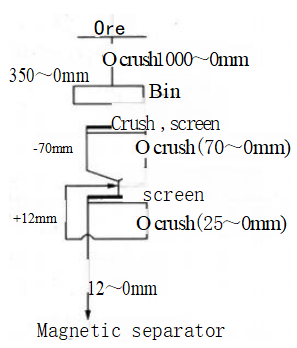
Figure 1 Crushing process of Dagushan Ore Processing Plant
Table 6 Crushing and Screening Equipment
| Process | workshop | model | pcs | capacity/(t/h) | working rate /% |
| coarse crusher | Crushing workshop | B1200mm gyratory crusher | 1 | 1186 | 24.27 |
| Mineral processing plant | PF900mm×1200mm jaw crusher | 1 | 256 | 46.32 | |
| medium crusher | Crushing workshop | H8800MC cone crusher | 2 | 1494 | 34.49 |
| Mineral processing plant | S240B cone crusher | 1 | 257 | 46.19 | |
| fine crusher | Crushing workshop | H8800 cone crusher | 4 | 495 | 53.04 |
| Mineral processing plant | S155D cone crusher | 2 | 129 | 46.29 | |
| Screening | Crushing workshop | 2YA2460 vibrating screen | 11 | mesh size 30mm×30mm,14mm×20mm | |
| Mineral processing plant | 2YA1848 vibrating screen | 4 | mesh size 30mm×35mm,14mm×20mm | ||
4.2 Magnetic Separation Workshop The process employs a staged grinding-single magnetic separation-fine screening and regrinding flow. This includes: three stages of grinding, six stages of magnetic separation (including three stages of dewatering), and two stages of fine screening. See Figure 2 for details.
Main equipment: 10 overflow mills (93600mm×6000mm, 6 in the first stage and 4 in the second stage); 5 overflow mills (92700mm×3600mm, 3 in the third stage); 10 hydrocyclone groups (6 in the first stage and 4 in the second stage); 24 magnetic separators (61200mm×3200mm, single-stage); 26 magnetic separators (BXø1050mm×2400mm, double and triple-stage); 7 magnetic separators (ø1050mm×3000mm, dewatering); 34 dewatering troughs (16 in the first stage, 10 in the second stage, and 8 in the third stage); 40 MVS electromagnetic vibrating screens (20 in the first stage and 20 in the second stage); Tailings reprocessing equipment: 92700mm×3600mm One overflow mill; eight JLCW150-90-14 disc reclaimers; five Ø3000mm dewatering tanks (two for primary dewatering and three for secondary dewatering); three BXØ1050mm×2400mm magnetic separators (one for primary magnetic separation); four MVS electromagnetic vibrating screens; two Ø1050mm×3000mm magnetic separators (for dewatering and magnetic separation). Tailings thickening equipment: six 653m thickeners (including one for tailings re-concentration). Equipment models and efficiency indicators are shown in Tables 7 and 8.
4.3 Three-stage beneficiation workshop: Adopts a continuous grinding-single magnetic separation-fine screening and regrinding process. This includes: three stages of grinding, eight stages of magnetic separation (including four stages of dewatering), and two stages of fine screening. The beneficiation process flow is shown in Figure 3.
Main equipment: 4 x 93200mm×3100mm grate mills (single stage); 4 x φ3200mm×3100mm overflow mills (double stage); 2 x Ø2700mm×3600mm overflow mills (triple stage); 4 x 02000mm double spiral classifiers (primary classification); 4 x Ø500mm×5 hydrocyclone groups (secondary classification); 8 x 61200mm×3200mm magnetic separators (single magnetic separator); 14 x BXs1050mm×2400mm magnetic separators (6 x two magnetic separators, 3 x three magnetic separators, and 5 x four magnetic separators); 3 x φ1050mm×2400mm magnetic separators (dewatering magnetic separation); 17 x 93000mm dewatering tanks (6 x single dewatering tanks). 3 units for secondary dewatering, 3 units for tertiary dewatering, and 5 units for quaternary dewatering; 20 units of MVS electromagnetic vibrating screens (10 units for primary stage and 10 units for secondary stage). Equipment models and efficiency indicators are shown in Tables 7 and 8.
4.4 Filtration Workshop
The dewatering and filtration process is shown in Figures 2, 3, and 4.
Main Equipment: 7 ZPG-72 disc filters (3 magnetic separators and 4 tertiary separators); 7 P60/15C ceramic filters;
11 BXs1200mm×3000mm dewatering magnetic separators (7 magnetic separators and 4 tertiary separators). Equipment models and efficiency indicators are shown in Tables 7 and 8.
Table 7 Grinding, Classification and Filtration Equipment
| Processing | workshop | model | pcs | capacity /(t/h) | working rate/% | overflow size (-0.074mm) content/% |
| Primary grinding and classification | magnetoc separator | g3600mm×6000mm overflow ball mill | 6 | 124.04 | 98.2 | 65.06 |
| Three-selection workshop | 93200mm×3100mm Grid ball mill | 4 | 74.71 | 98.27 | – | |
| Mineral processing plant | 92700mm×3600mm overflow ball mill | 3 | 43.99 | 90.77 | – | |
| Secondary grinding and classification | magnetic separator workshop | 93600mm×6000mm overflow ball mill | 4 | – | 92.05 | |
| Three-selection workshop | 63200mm×3100mm overflow ball mill | 4 | – | 一 | 86.86 | |
| Mineral processing plant | 2700mm×3600mm overflow ball mill | 3 | – | – | ||
| Three-stage grinding and classification | magnetic separator workshop | 2700mm×3600mm overflow ball mill | 5 | – | – | 二 |
| Three-selection workshop | 62700mm×3600mm overflow ball mill | 2 | – | 一 | – | |
| Mineral processing plant | 61800mm×4000mm overflow ball mill | 1 | – | – | 二 | |
| magnetic separator workshop | 72m² External Filter Vacuum Filter | 3 | – | – | 一 | |
| Filter | Three-selection workshop | 72m² External Filter Vacuum Filter | 4 | 56.81 | 52.41 | 51.74 |
| Mineral processing plant | – | – | – | – | – |
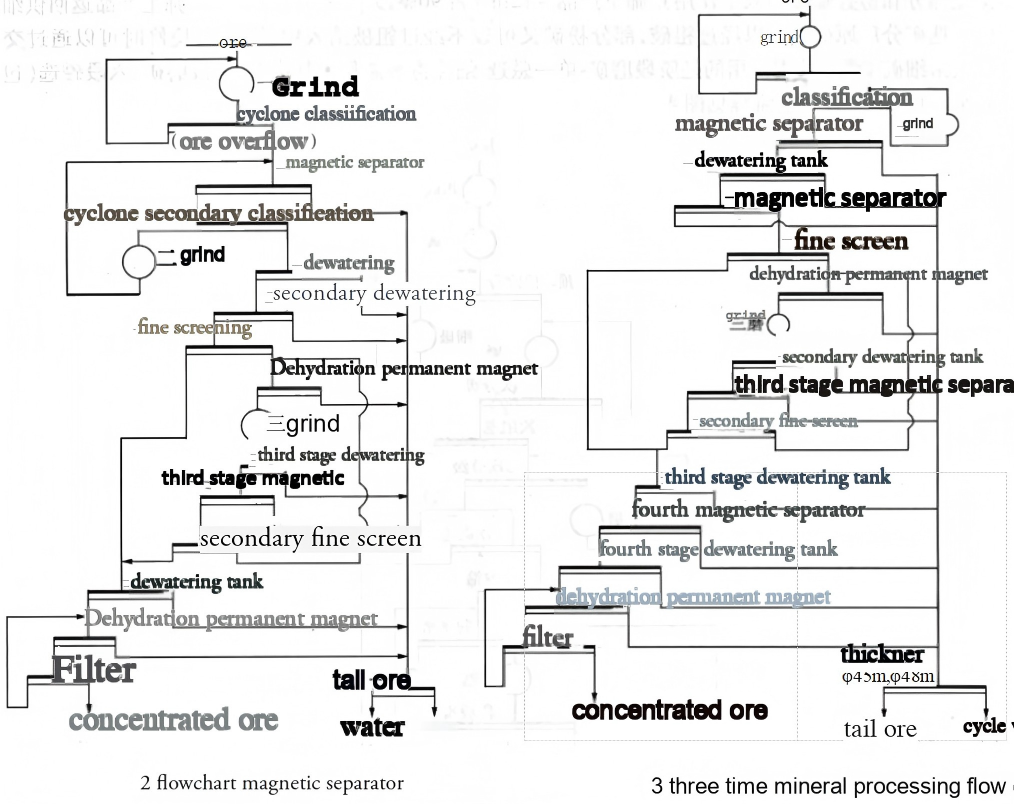
Table 8 Selection of Re-grinding Equipment
| Process | Magnetic Separation Workshop | Three-selection workshop | Mineral processing plant | ||||
| model | Number of units | model | Number of units | model | Number of units | ||
| Before screening Selection | One-time magnetic separator | XCTB1232 Drum Magnetic Separator | twenty four | XCTB1232 Drum Magnetic Separator | 8 | BX-1024 | 6 |
| One-time dehydration tank | 63000mm permanent magnet external magnetic dewatering tank | 16 | 63000mm permanent magnet external magnetic dewatering tank | 6 | 63000mm permanent magnet external magnetic dewatering tank | 4 | |
| Secondary magnetic separator | BX1024 Semi-counterflow drum magnetic separator | 16 | BX1024 Semi-Countercurrent Magnetic Separator | 6 | BX1024 | 4 | |
| fine sieveGrind again | Dewatering magnetic separator | CTB1030 Semi-countercurrent Drum Magnetic Separator | 7 | CTB1024 Semi-countercurrent Magnetic Separator | 3 | CTB1024 | 2 |
| One sieve | MVS electromagnetic vibration high-frequency vibrating screen | 20 | MVS electromagnetic vibration high-frequency vibrating screen | 10 | – | – | |
| Second screening | MVS electromagnetic vibration high-frequency vibrating screen | 20 | MVS electromagnetic vibration high-frequency vibrating screen | 10 | – | ||
| Secondary dehydration tank | 93000mm permanent magnet external magnetic dewatering tank | 10 | 93000mm permanent magnet external magnetic dewatering tank | 3 | two | – | |
| Three-stage magnetic separator | BX1024 Semi-counterflow drum magnetic separator | 10 | BX1024 Semi-counterflow drum magnetic separator | 4 | – | ||
| Three-stage dehydration tank | 63000mm permanent magnet external magnetic dewatering tank | 8 | 63000mm permanent magnet external magnetic dewatering tank | 3 | 63000mm permanent magnet external magnetic dewatering tank | 2 | |
| Four-stage magnetic separator | one | – | BX1024 Semi-counterflow drum magnetic separator | 5 | one | – | |
| Four-stage dehydration tank | – | two | 63000mm permanent magnet external magnetic dewatering tank | 5 | – | ||
| Pre-filtration magnetic separator | BX1230 Semi-Countercurrent Magnetic Separator | 7 | BX1230 Semi-Countercurrent Magnetic Separator | 4 | – | one | |
4.5 Mineral Processing Plant The crushing process adopts a three-stage closed-circuit crushing process. The discharge from the intermediate and fine crushers is combined and fed into the screening unit (also known as pre-screening, serving a dual purpose of pre-screening and inspection). Over 90% of the undersize product (-12mm) is conveyed to the grinding bin, while the oversize product is returned to the fine crusher. The raw ore in the mineral processing plant can undergo coarse crushing, and some fine ore can be fed directly to the intermediate crusher without coarse crushing (during intermediate crusher maintenance, it can be directly fed to the fine crusher via a cross chute). The beneficiation process uses a staged grinding-single magnetic separation-fine screening and regrinding process. This includes: three stages of grinding, six stages of magnetic separation (including three stages of dewatering), and two stages of fine screening. The process flow is shown in Figure 4.
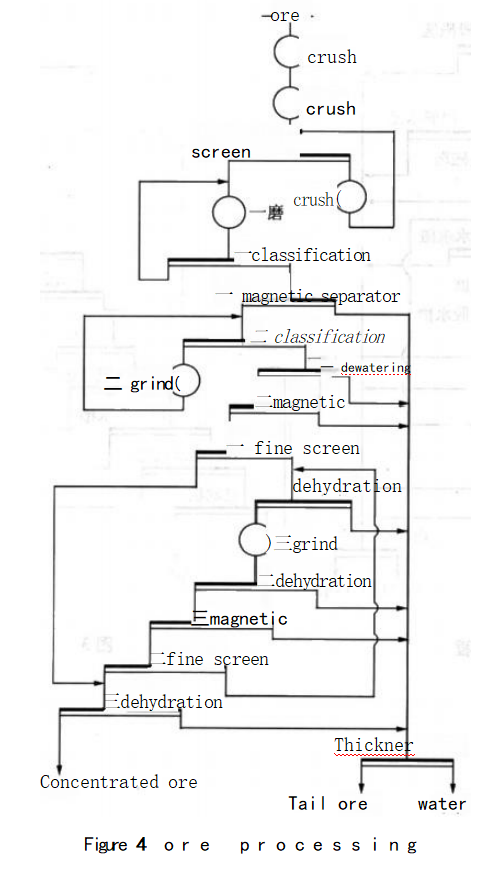
The Dagushan ore dressing plant’s beneficiation branch is designed to process 1.3 million tons of raw ore annually. It mainly consists of crushing, beneficiation, and tailings treatment systems. It was officially completed and put into operation in July 2006. The crushing system adopts a three-stage closed-circuit process; the feed particle size is 750-0 mm, and the product particle size is 15-0 mm. The beneficiation system uses a staged grinding-single magnetic separation-fine screening and regrinding process, with a final concentrate grade of 67.20%. The concentrate is transported by two-stage pumps to the Dagushan ore dressing plant’s filtration workshop for dewatering and filtration, becoming the final concentrate. Tailings from each beneficiation stage are concentrated by a thickener; the overflow is reused as circulating water, and the underflow is transported to the Dagushan ore dressing plant’s tailings pond by a primary pump.
Main equipment: PE900mm×1200mm pendulum jaw crusher (one unit); GZT1560 bar vibrating feeder (one unit); XJG-110 rubber spring vibrating feeder (one unit); S240B standard cone crusher (one unit); S155D short-head cone crusher (one unit); 1800mm×4800mm 2YA circular vibrating screen (4 units); O2700mm×3600mm overflow mill (6 units, 3 units for primary and 3 units for secondary); ZM2400mm×3600mm overflow mill (1 unit, for tertiary); GZM1830×4000 overflow mill (1 unit, for tertiary); 9350mm×6 hydrocyclone group (3 groups, for primary classification); 9350mm×5 Three hydrocyclone groups (secondary classification); twelve BXg1050mm×2400mm magnetic separators (six single-stage, four double-stage, and two triple-stage); two CTB-1024 magnetic separators (dewatering magnetic separation); eight 93000mm dewatering troughs (four single-stage, two double-stage, and two triple-stage); ten MVS electromagnetic vibrating screens (four single-stage and six double-stage); one 953m thickener. Equipment models and efficiency indicators are shown in Tables 6, 7, and 8.
4.6 Tailings Workshop The Dagushan ore dressing plant uses a single magnetic separation process, processing approximately 9 million tons of raw ore annually. It discharges approximately 2.5 million tons of tailings annually with a grade of 11.7%. These tailings contain some liberated iron minerals and intergrowths. The tailings workshop is where the tailings reprocessing is carried out.
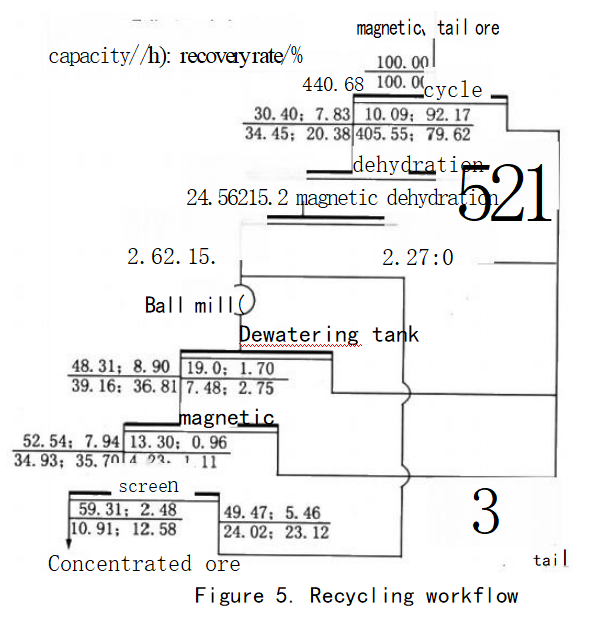
There are two online tailings recovery points at the Dagushan concentrator: one at the concentrator workshop of Daxuan Comprehensive Industrial Company and the other at the tailings recovery point of the third concentrator workshop of Daxuan Industrial Company. The recovery process is shown in Figure 5.
Main equipment: 61600mm×8mm disc recoverer; 6750mm×1800mm permanent magnet dewatering machine; 61500mm×3000mm ball mill; two 2.0m dewatering tanks; a 6750mm×1800mm low-field-strength vibrating magnetic separator; a 0.15mm high-frequency vibrating fine screen; a 3.0m dewatering tank; and one 8m² filter.
4.7 Main Technical and Economic Indicators
Table 9 shows the main technical and economic indicators of the magnetic separation workshop, the third separation workshop, and the mineral processing branch from 2000 to 2007.
| workshop | year | ore grade % | concentrated ore/% | tail /% | rate /(t/t) | capacity /[(pcs ·h)] | ball mill working rate/% | capacity/100000 t | concentrated ore/100000t | capacity /(t/d) | size (-12mm)/% | goodsize/% |
| magnetic separator | 2000 | 31.96 | 66.21 | 9.46 | 2.52 | 36.59 | 85.26 | 383.67 | 159.88 | 4380 | 90.97 | 94.77 |
| 2001 | 31.88 | 66.21 | 8.84 | 2.49 | 35.45 | 87.92 | 382.28 | 171.07 | 4687 | 90.81 | 95.20 | |
| 2002 | 31.76 | 66.47 | 8.82 | 2.51 | 34.32 | 90.99 | 382.96 | 170.06 | 4659 | 91.32 | 96.27 | |
| 2003 | 31.76 | 66.63 | 8.70 | 2.51 | 35.98 | 93.32 | 411.78 | 183.66 | 5032 | 90.79 | 93.73 | |
| 2004 | 31.49 | 66.63 | 8.73 | 2.54 | 42.12 | 93.98 | 435.94 | 192.82 | 5268 | 93.98 | 98.16 | |
| 2005 | 30.60 | 67.15 | 8.80 | 2.68 | 102.77 | 96.45 | 607.08 | 253.81 | 6954 | 89.74 | – | |
| 2006 | 30.13 | 67.26 | 8.74 | 2.74 | 121.62 | 97.61 | 623.95 | 253.53 | 6946 | 93.60 | 99.60 | |
| 2007(1~6) | 30.70 | 67.29 | 8.74 | 2.67 | 124.04 | 98.20 | 317.48 | 131.49 | 7265 | 93.47 | 100 | |
| 三 separator | 2000 | 31.85 | 64.42 | 9.38 | 2.45 | 62.51 | 87.57 | 192.35 | 89.82 | 2461 | 90.78 | 92.67 |
| 2001 | 31.70 | 65.43 | 8.77 | 2.47 | 59.34 | 90.89 | 188.99 | 91.89 | 2518 | 90.70 | 92.43 | |
| 2002 | 31.81 | 66.47 | 8.73 | 2.50 | 61.00 | 93.03 | 198.82 | 95.99 | 2630 | 91.76 | 99.17 | |
| 2003 | 32.12 | 66.67 | 8.72 | 2.48 | 64.86 | 94.20 | 214.10 | 104.24 | 2856 | 91.27 | 98.31 | |
| 2004 | 31.86 | 66.63 | 8.76 | 2.51 | 68.30 | 95.88 | 230.11 | 110.50 | 3019 | 95.29 | 98.59 | |
| 2005 | 30.71 | 66.73 | 8.80 | 2.64 | 67.88 | 97.11 | 231.00 | 105.17 | 2881 | 89.71 | – | |
| 2006 | 30.17 | 67.21 | 8.73 | 2.73 | 72.60 | 97.65 | 248.41 | 101.92 | 2792 | 93.46 | 98.93 | |
| 2007(1~6) | 30.73 | 67.29 | 8.74 | 2.67 | 74.71 | 98.27 | 127.57 | 51.74 | 2858 | 93.36 | 100 | |
| processing plant line | 2006 | 24.56 | 67.26 | 9.37 | 3.81 | 42.34 | 89.90 | 50.43 | 13.60 | 739 | – | |
| 2007(1~6) | 26.84 | 67.29 | 9.34 | 3.32 | 43.99 | 90.77 | 52.04 | 17.24 | 953 | – | – |
 English English
  Spanish
 Russian
 Arabic
 Swahili
 French
 Turkish
 Portuguese
 Korean
 Japanese
 German
 Italian