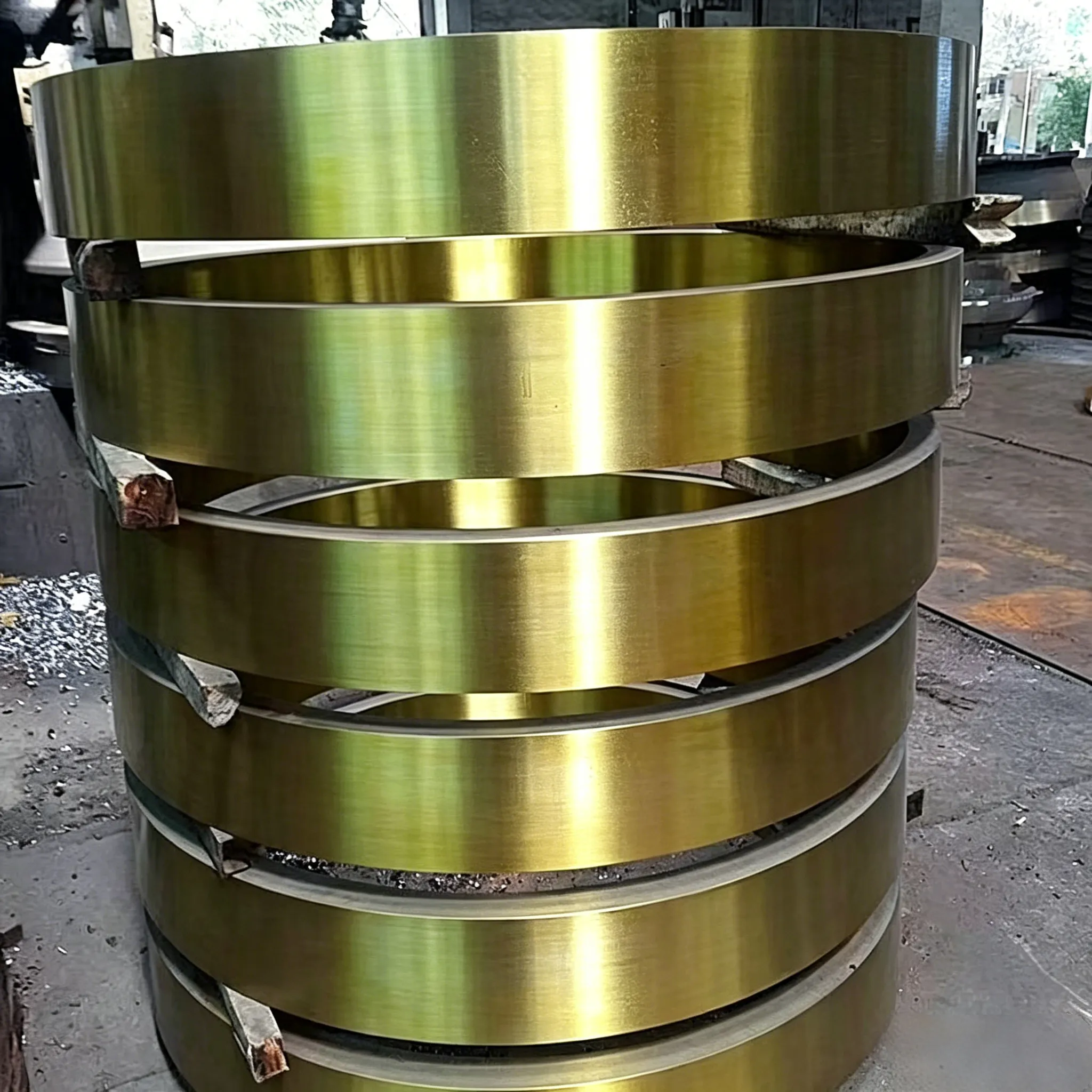
Raymond Mill Grinding Ring
Raymond Mill Grinding Ring – Comprehensive Product Detail Page 1. Product Overview…


The relative rotation between the hollow shaft and the bearing bushing generates frictional heat. Strictly speaking, the heat is produced by the shearing of the oil film between them, which raises the bearing temperature. This contribution is relatively small in magnitude.
During mill operation, only a small portion of the total energy input is used for grinding the material, while most of the energy is converted into heat and sound energy. As a result, the material absorbs a significant amount of heat, and when it flows through the discharge hollow shaft or slide ring, this heat is transferred to the bearing bushing. For example, in a cement mill equipped with an internal water spray system, the discharge material temperature is around 120°C. Without water spray, and if the clinker fed into the mill is not sufficiently cooled, the discharge material temperature can exceed 160°C. Such high-temperature material continuously flowing through the hollow shaft and slide ring carries a substantial amount of heat, causing a significant rise in the main bearing bushing temperature, which can reach 70–80°C or even higher.
The heat transferred from the material to the main bearing bushing accounts for the largest proportion of the temperature rise.
Different types of mills have varying effects on the temperature rise of the bearing bushings.
In a wet raw mill, where slurry is fed, the temperature rise inside the mill is low, and the discharge main bearing bushing temperature is the lowest. In a cement mill, the discharge main bearing bushing temperature is the highest. In drying raw mills and air-swept coal mills, hot air is introduced along with the feed. If kiln exhaust gas is used for drying, the inlet gas temperature can reach 350°C; if an auxiliary hot-air furnace is used, the inlet gas temperature can reach 450°C. Consequently, the feed main bearing bushing temperature in such mills is higher than in conventional mills.
Thermal insulation layers are provided between the feed/discharge screw barrels (cone sleeves) and the hollow shaft to reduce heat transfer from the material to the hollow shaft and subsequently to the bearing bushing. Some mills have thin insulation layers, while others have thicker ones. For the discharge main bearing bushing of a cement mill, a thicker insulation layer is desirable to block heat transfer.
Similarly, in slide shoe bearings, the slide ring protruding outside the mill shell is farther from the material and thus operates at a lower temperature. However, for welded slide rings, which are close to the material and have no insulation layer between them and the liners, the bearing bushing temperature is the highest, potentially reaching 85–90°C.
The ambient temperature around the mill also affects the bearing bushing temperature. Factors such as season, geographic location, and even the ventilation level of the workshop play a role. For example, at a certain cement plant, the coal mill was installed outdoors directly beside the rotary kiln, resulting in extremely high ambient temperatures and harsh operating conditions. In such cases, the influence of ambient temperature on the bushing temperature increases dramatically.
The cooling water for the mill main bearings serves two purposes: one is the water circulating through the main bearing bushing, and the other is the water in the cooler of the main bearing dilute oil station.
The temperature and flow rate of the cooling water have a significant effect on the bushing temperature, especially the water temperature. Water sources vary—some plants use river or lake water, while others use groundwater—so the inlet cooling water temperature differs accordingly. Water temperature is also affected by season. At a cement plant located by Lake Taihu, the shallow lake water became quite warm during hot summer months, rendering it ineffective for cooling, which caused the bushing temperature to rise. In contrast, using groundwater provided a noticeably better cooling effect.
Admittedly, when the bushing temperature is high and the cooling water inlet temperature cannot be changed, increasing the water flow rate is a viable measure for temperature reduction.
The main bearing dilute oil station has two functions. First, it supplies the oil flow required to establish the hydrodynamic oil film. Second, it removes excess heat and cools the bearing bushing. Typically, an oil flow of 6–10 L/min is sufficient to form the hydrodynamic oil film, while FLS uses 16 L/min. In China, the flow rate is usually 25 L/min, and in some cases even 45 L/min. This higher flow rate accounts for the additional oil required to carry away heat.
 English English
 Spanish
 Russian
 Arabic
 Swahili
 French
 Turkish
 Portuguese
 Korean
 Japanese
 German
 Italian