
Dry Ball Mill
1. Product Overview The dry ball mill is a key piece of…

Bauxite (also known as alumina ore) is an earthy mineral whose main component is alumina. It is the most important raw material for producing metallic aluminium and manufacturing refractories. Global bauxite production continues to grow, with alumina output from China, Australia, Indonesia, and other countries accounting for 45% of total global supply.
In industries such as refractories, precision casting, ceramics, and chemicals, bauxite is not used directly as run‑of‑mine ore. Instead, it must undergo a series of deep‑processing steps including crushing, grinding, and classification to produce bauxite powder of various fineness levels. The fineness, purity, and particle size distribution of bauxite powder directly determine the performance of the final product—from the corrosion resistance of refractory bricks to the suspension properties of casting coatings—all of which are closely linked to the quality of the grinding process.
What challenges does bauxite grinding face? What are the pros and cons of different grinding equipment? How does a complete production line operate? This article provides a comprehensive analysis of bauxite grinding systems, covering raw material characteristics, equipment selection, process flow, application scenarios, and more.
Bauxite, also known as alumina ore, is mainly composed of alumina (Al₂O₃) and consists of hydrated aluminium oxides containing impurities. Its colour is typically white or greyish‑white, turning brownish‑yellow or light red when containing iron. The density is about 3.45 g/cm³, it is opaque and brittle. Bauxite is extremely difficult to melt, insoluble in water, but soluble in sulfuric acid and sodium hydroxide solution.
The main mineral components of bauxite are diaspore, boehmite, and gibbsite. In the refractories industry, bauxite usually refers to the calcined clinker with an Al₂O₃ content of ≥48%.
Grinding bauxite is not a simple pulverising operation; the main difficulties include:
High moisture content: Natural bauxite can have a moisture content of up to 15%, requiring drying before or during grinding.
Large hardness variations: Pure bauxite has a Mohs hardness of 1–3, making it relatively soft. However, the presence of impurities significantly increases grinding difficulty. Bauxite from different origins and grades varies greatly in hardness, imposing higher demands on equipment adaptability.
Diverse fineness requirements: The refractories industry commonly uses 200–400 mesh (45–74 μm) bauxite powder. With the development of high‑end applications, ultra‑fine powder requirements have extended to the 2500 mesh level. Different fineness levels require different equipment and process parameters.
Strict purity requirements: High‑quality bauxite fine powder requires an Al₂O₃ content ≥70%, with impurities such as Fe₂O₃ and CaO strictly controlled within the permissible process limits.
These characteristics mean that bauxite grinding requires targeted equipment selection and refined process control.
The core equipment for bauxite grinding mainly falls into three categories: Raymond mills, vertical roller mills, and ultra‑fine grinding mills. Each has its advantages and disadvantages and is suitable for different production scenarios.
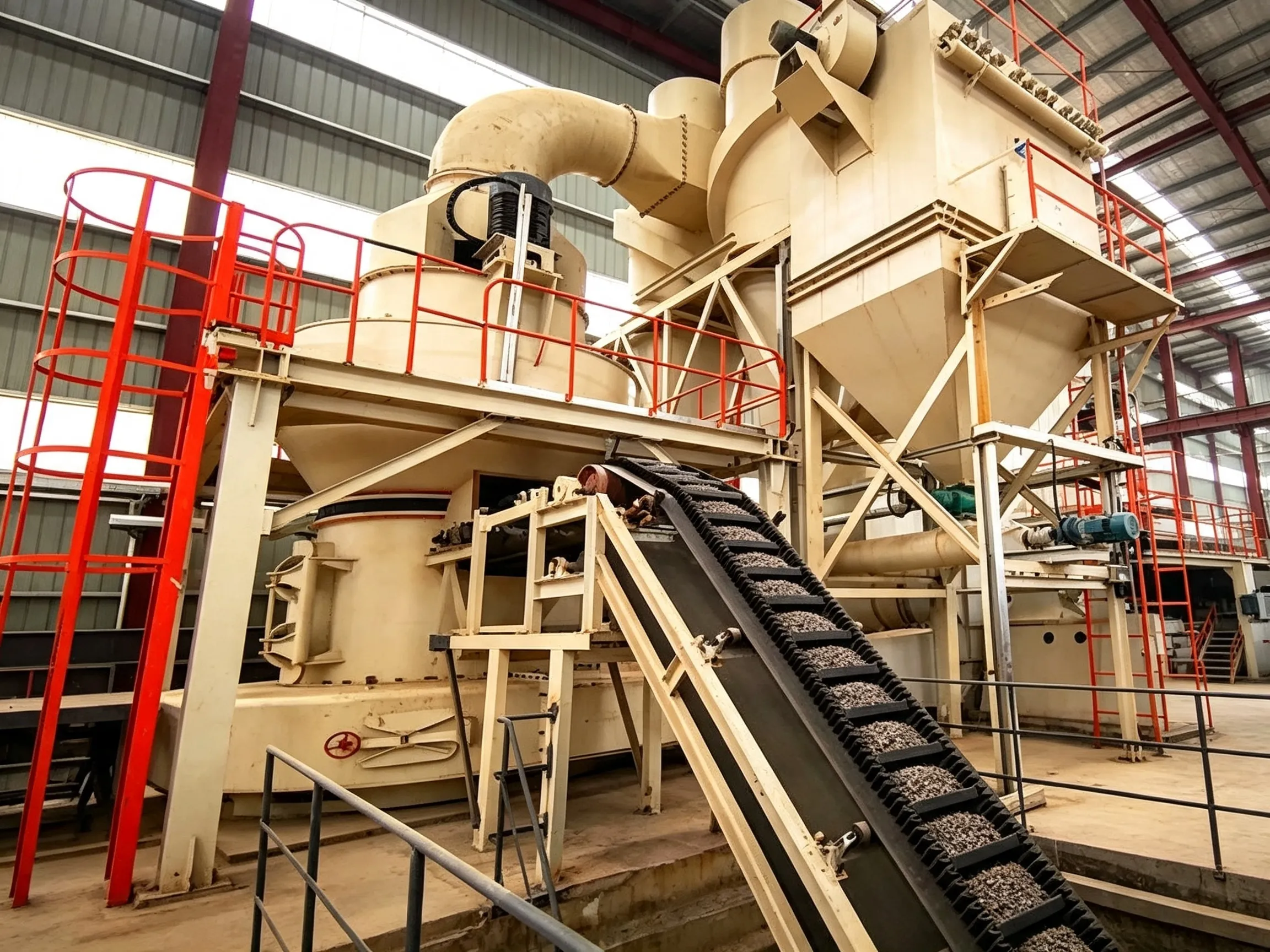
The Raymond mill is a closed‑circuit system integrating crushing, grinding, and classification. It is particularly suitable for bauxite with a Mohs hardness of 1–3.
Working principle: The main unit drives the plum blossom frame to rotate. Under centrifugal force, the grinding rollers press tightly against the grinding ring and roll over the material fed by the shovel blade. Airflow carries fine powder upward to the classifier, where coarse particles fall back for re‑grinding and qualified fine powder enters the collection system.
Key advantages:
Applicable scenarios: Small‑to‑medium‑scale production (1–25 t/h) with conventional fineness requirements (80–400 mesh).
The vertical roller mill (VRM) has become the mainstream upgrade direction in bauxite processing in recent years, particularly suited for large‑scale continuous production.
Key advantages:
Applicable scenarios: Large‑scale industrial production (tens of thousands to hundreds of thousands of tons per year), with high requirements for energy efficiency, environmental performance, and automation.
For ultra‑fine powder requirements (e.g., refractory fibres, precision casting), specialised ultra‑fine grinding equipment is needed.
SCM series ultra‑fine mills are widely used in paints, papermaking, pigments, rubber, plastics, fillers, cosmetics, and other industries.
LUM ultra‑fine vertical mills and MW ring roller mills focus on ultra‑fine grinding in the 400–3250 mesh range, with adjustable and controllable fineness.
| Comparison Aspect | Raymond Mill | Vertical Roller Mill | Ultra‑Fine Mill |
|---|---|---|---|
| Product Fineness | 80–400 mesh | 80–2500 mesh | 400–3250 mesh |
| Single‑unit Capacity | 1–25 t/h | Up to 40+ t/h | Depends on model |
| Drying Capability | Requires pre‑drying | Handles up to 15% moisture | Requires pre‑drying |
| System Energy Consumption | Moderate | Low (40%–50% lower than ball mill) | Moderate |
| Integrated Functions | Grinding + classification | Grinding + drying + classification + conveying | Grinding + classification |
| Capital Investment | Lower | Moderate | Higher |
| Suitable Scale | Small to medium | Large‑scale continuous production | High‑end ultra‑fine needs |
| Automation Level | General | PLC intelligent control | High |
Selection recommendations:
A standard bauxite grinding production line typically includes the following core stages:
Calcination (optional): For the refractories industry, bauxite usually needs to be calcined at high temperature (rotary kiln at 1400–1600°C) to remove crystal water and carbon dioxide and to restructure the mineral crystal lattice.
Crushing: Large bauxite is coarse‑crushed by a jaw crusher to 50–80 mm, then fine‑crushed by an impact crusher to ≤30 mm. Some processes require crushing to ≤10 mm before feeding.
Screening: The crushed material is strictly screened by a vibrating screen to remove impurities and oversized particles.
Iron removal: Magnetic separators and metal detectors remove ferrous impurities, protecting equipment and improving product purity.
After pre‑treatment, the bauxite is conveyed by a bucket elevator to a storage hopper, and then fed uniformly, quantitatively, and continuously into the grinding mill via an electromagnetic vibrating feeder.
Material enters the mill and is crushed, ground, and pulverised between the grinding rollers and ring (or between the table and rollers). For VRMs, a hot‑gas system can simultaneously introduce high‑temperature airflow for on‑line drying during grinding.
The ground material is carried upward by airflow to the classifier. By adjusting the classifier rotor speed, the finished fineness can be precisely controlled. Coarse particles fall back for re‑grinding, while qualified fine particles are carried by airflow to the collection system.
Dust‑laden gas first passes through a cyclone collector for primary collection, then through a pulse‑jet bag filter for deep purification. Collection efficiency can exceed 99.8%. The collected bauxite powder is discharged through a discharge valve and sent to the finished product silo for storage or direct packaging.
Bauxite Ore → Crushing (Jaw Crusher + Impact Crusher) → Screening → Iron Removal → Bucket Elevator → Storage Hopper → Feeder → Grinding Mill (Grinding + Classification) → Cyclone Collector → Pulse‑Jet Bag Filter → Finished Product Silo
After grinding, bauxite powder plays a key role in many industries:
Bauxite powder is the core raw material for high‑alumina refractories. High‑alumina bauxite clinker has a refractoriness of up to 1780°C, strong chemical stability, and good physical properties.
Calcined bauxite clinker is ground into fine powder and used to make moulds for precision casting in military, aerospace, communications, instrumentation, machinery, and medical devices. Bauxite sand (powder) is suitable for investment casting surface coating and stucco materials, offering low thermal expansion, high refractoriness, and good chemical stability.
Bauxite is the main raw material for producing alumina and metallic aluminium, widely used in defence, aviation, automotive, electrical, chemical, and many other fields.
Finely ground bauxite powder can improve glaze suspension, lower firing temperatures, and enhance ceramic quality.
Liming Heavy Industry designed and built a 300,000 t/y bauxite powder project. Using self‑developed core grinding technology, the utilisation rate of local bauxite tailings increased from 10% to over 90% , achieving an industrial upgrade from “low‑efficiency coarse processing” to “full‑value deep processing.” The project is equipped with advanced dust removal equipment, with dust emissions far below national standards.
Guilin Hongcheng provided HLM1300 and HLM2400 vertical roller mills to a technology company in Guizhou for bauxite powder production. After adopting the HLM2400 VRM to process bauxite tailings, the previously discarded low‑grade ore was converted into high‑value‑added refractory raw materials, reducing slag accumulation area by 60% and raw material costs by 35%.
A Shanxi alumina enterprise adopted an HLM2000 vertical roller mill. The processing efficiency of bauxite raw meal increased by over 40%, energy consumption dropped by 35%, fineness was stable at 200 mesh (D91 standard), and output reached 13 t/h.
A bauxite grinding production line in Lüliang, Shanxi, was commissioned in April 2018. The customer required a fineness of 200 mesh and a capacity of 8 t/h. Given the relatively high hardness of bauxite, the project adopted a YGM160 high‑pressure mill.
Global alumina and bauxite production is increasing steadily. Strong domestic demand has driven Chinese bauxite producers to seek overseas mining opportunities. As downstream industries such as refractories, precision casting, and ceramics continue to develop, market demand for bauxite powder will grow steadily.
The state strongly promotes new energy‑saving technologies, with vertical roller mill technology and equipment listed as key promotion directions. The scientific treatment of bauxite tailings promotes the development of the national circular economy in mining, opening new growth opportunities for mining enterprises.
Intelligence: Advanced control systems and automation equipment are widely applied, continuously improving production efficiency. PLC intelligent control enables on‑line fineness adjustment.
Large‑scale: 300,000 t/y and even larger bauxite powder production lines are gradually becoming mainstream.
Green: Low‑carbon concepts are integrated with high‑efficiency dust removal equipment. Hot‑air recirculation technology can handle raw materials with 15% moisture without pre‑drying.
Bauxite grinding processing is a critical step in transforming natural minerals into high‑value industrial raw materials. From the flexible and efficient Raymond mill to the large‑scale, energy‑saving vertical roller mill, and from conventional fineness to 2500‑mesh ultra‑fine powder, different equipment options and process solutions correspond to different application scenarios and market demands.
Driven by policy support, technological progress, and market demand , the bauxite grinding industry is embracing broad development prospects. Whether for refractories, precision casting, or ceramics and chemicals, high‑quality bauxite powder will remain the cornerstone supporting the high‑quality development of these industries.
For mining and powder processing enterprises, choosing a scientifically designed bauxite grinding system is not only key to increasing product added value but also a strategic move to seize market opportunities.


 English English
 Spanish
 Russian
 Arabic
 Swahili
 French
 Turkish
 Portuguese
 Korean
 Japanese
 German
 Italian